
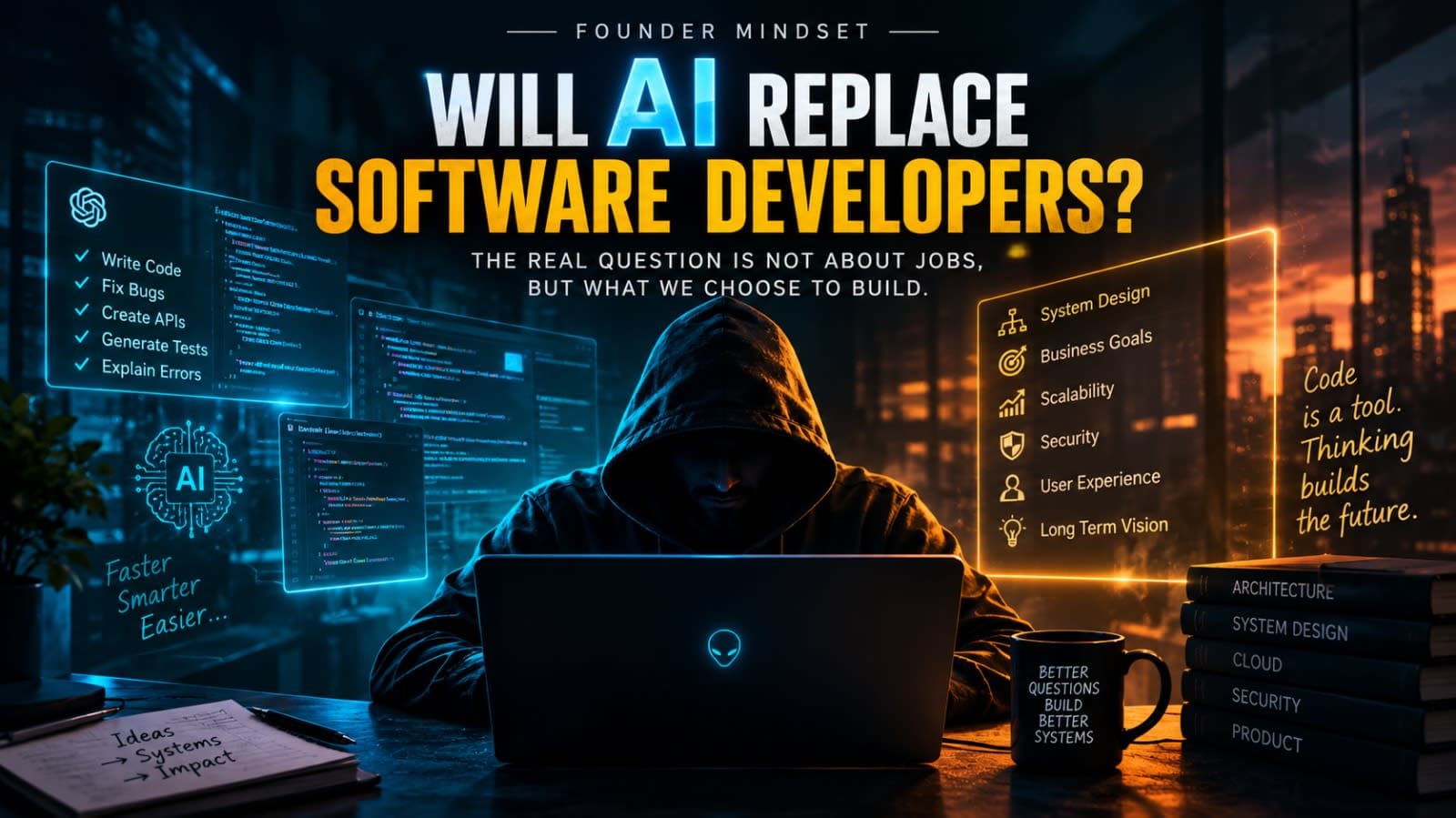
Maybe the better question is: What happens to a developer when machines learn to write code?
For decades, software development was closely associated with one thing: writing code.
A developer would sit in front of a screen for hours, searching documentation, reading Stack Overflow, debugging errors, designing APIs, writing functions, testing implementations, and trying to understand why something that looked correct somehow refused to work.
Today, that world is changing.
AI can write functions.
AI can generate APIs.
AI can explain errors.
AI can create tests.
AI can translate code from one programming language to another.
AI can even help build entire applications from natural-language instructions.
So the fear is understandable:
If AI can write code, what happens to the people whose job was to write that code?
But perhaps we are asking the wrong question.
The real question is not: "Will AI replace software developers?"
It is: "Will AI replace the developer who only knows how to write code?"
And that question has a very different answer.
Coding Is Not the Same as Software Development
There is a difference between writing code and building software.
Code is a tool.
Software is a system.
A developer does not simply decide what code to write. A good developer first has to understand why the software exists.
The Questions Behind Good Software
Before writing code, a developer has to consider questions such as:
What problem is the software solving?
Who is going to use it?
What happens when 10 users become 10 million?
What happens when the database becomes too large?
What happens when the system fails at 3 AM?
How should user data be protected?
How should authentication work?
Which architecture should be used?
What should happen five years from now when the original developer is no longer maintaining the system?
These are not merely coding questions.
They are engineering questions.
And they require context, judgment, and responsibility.
AI can propose an answer.
But someone still has to determine whether that answer should be trusted.
That distinction is becoming increasingly important.
In Stack Overflow's 2025 Developer Survey, 84% of respondents said they were using or planning to use AI tools in their development process. Yet 46% said they actively distrust the accuracy of AI output, compared with 33% who trust it.
That is a fascinating contradiction.
Developers are using AI more while trusting it less.
Why?
Because experienced developers understand something beginners often discover the hard way:
Code that looks correct is not necessarily code that is correct.
AI Is Extremely Good at Repetitive Work
Imagine a developer needs to create 50 similar APIs.
Before AI, much of that work could involve repeatedly writing similar structures, checking documentation, creating validation logic, writing tests, and fixing small errors.
Now a developer can describe the required pattern and let AI generate much of the initial implementation.
The developer becomes less of a typist and more of an orchestrator.
This is not necessarily the destruction of software development.
It is the evolution of software development.
We Have Seen This Pattern Before
We have seen similar changes throughout the history of computing:
Compilers replaced the need to manually translate high-level instructions into machine code.
Libraries replaced the need to rebuild common functionality from scratch.
Cloud computing removed much of the need to physically manage servers.
Frameworks removed enormous amounts of repetitive infrastructure work.
Developers did not disappear.
The abstraction level changed.
AI is pushing that abstraction level even higher.
The developer who once spent the morning writing 50 similar APIs may now spend that morning deciding whether those 50 APIs should exist at all.
That is a very different job.
The Strange Paradox of AI
Here is where things become philosophical.
The better AI becomes at writing code, the less valuable typing code becomes.
But that does not necessarily make developers less valuable.
It can make thinking more valuable.
Imagine two developers.
Developer A
Developer A knows five programming languages but cannot explain why the system should be designed a particular way.
Developer B
Developer B knows one language extremely well, understands:
Architecture
Security
Databases
Cloud infrastructure
Business requirements
System design
Give both of them AI.
Developer A may produce thousands of lines of code.
Developer B may produce a better system with a few carefully chosen instructions.
Why?
Because AI amplifies capability. It does not automatically create judgment.
A powerful AI in the hands of someone who understands software architecture can be extraordinarily useful.
The same AI in the hands of someone who does not understand what they are building can generate extraordinarily complicated mistakes.
AI Can Write the Code. Who Owns the Consequences?
This may be the most important question.
Imagine an AI generates an authentication system.
It looks clean.
It compiles.
The tests pass.
The application launches.
Six months later, someone discovers that a flaw in the authentication logic exposed customer information.
Who does the company blame?
The AI?
No.
The company will ask:
Who designed the system?
Who reviewed the code?
Who approved it?
Who was responsible for security?
The AI does not attend the meeting with the lawyers.
It does not explain the decision to the customer.
It does not carry the responsibility.
The developer or engineering organization does.
That is why software development is more than code generation.
Responsibility cannot simply be generated by a prompt.
And AI Is Not Always Faster
There is another uncomfortable truth.
AI does not automatically make every developer faster.
A 2025 randomized controlled trial by METR involving experienced open-source developers found that developers using the AI tools studied took 19% longer to complete tasks than developers working without those tools.
That result does not mean AI is useless.
It means something more interesting:
AI productivity depends on the task, the developer, the tools, and the ability to verify the output.
Sometimes AI produces an excellent solution in seconds.
Sometimes it produces a solution that is almost correct.
And "almost correct" can be more dangerous than obviously wrong.
Stack Overflow's 2025 survey found that 66% of developers were frustrated by AI solutions that were "almost right, but not quite," while 45% said debugging AI-generated code could be more time-consuming.
This is one of the hidden costs of AI.
Generating code is becoming cheap. Understanding whether the generated code is actually good remains expensive.
The Developer's New Superpower: Knowing What to Ask
In the past, programming skill was heavily connected to knowing how to write code.
The future will increasingly reward something else:
Knowing what should be built.
Imagine telling AI:
Build me a scalable payment system.
AI can generate an impressive amount of code.
But what happens next?
The Questions Above the Code
Should the system use a particular payment architecture?
How should failed transactions be handled?
What happens if the payment succeeds but the database transaction fails?
How are refunds processed?
How is sensitive information protected?
What happens during a network timeout?
How do you prevent duplicate payments?
What happens when millions of users arrive simultaneously?
These questions exist above the code.
The AI can help answer them.
But someone must understand the problem deeply enough to ask the right questions.
And that may become one of the most valuable skills in software engineering.
The Beginner Has More Power Than Ever
There is also a beautiful side to this revolution.
AI has dramatically lowered the barrier to creating software.
Someone who previously needed months to learn enough programming to build a simple application can now describe an idea and receive working code.
That is powerful.
What AI Enables
A designer can prototype an application.
A founder can build an MVP.
A small business owner can automate a workflow.
A student can experiment with ideas that previously required an entire development team.
But there is a danger.
AI makes it easier to create software without making it easier to understand software.
A person can build something without understanding databases.
They can deploy something without understanding security.
They can generate an authentication system without understanding authentication.
They can create an application without understanding scalability.
And when something breaks, they may not know why.
That is why the fundamentals still matter.
In fact, they may matter even more.
The Future Developer May Look Very Different
The developer of the future may spend less time typing code and more time doing things such as:
Designing systems
Defining requirements
Reviewing AI-generated code
Testing edge cases
Designing architecture
Managing security
Understanding users
Connecting technology to business goals
Managing AI agents
Making technical decisions
The keyboard may become less important. The mind behind the keyboard may become more important.
This is already visible in developer behavior.
Stack Overflow's 2025 survey found that 52% of developers reported that AI tools or agents had positively affected their productivity. At the same time, developers remained particularly reluctant to hand over high-responsibility activities such as deployment, monitoring, and project planning entirely to AI.
That tells us something important.
Developers are not necessarily resisting AI.
They are learning where to trust it and where not to trust it.
So, Will AI Replace Software Developers?
Maybe some of them.
That possibility should not be dismissed.
If a company needs developers primarily to perform repetitive coding tasks, AI may reduce the number of people required to perform those tasks.
That is real.
The future may require fewer people to produce the same amount of code.
But fewer people writing code does not automatically mean the disappearance of software engineering.
The World Economic Forum's Future of Jobs Report 2025 actually places software and application developers among the fastest-growing roles expected through 2030. The same report predicts substantial job disruption overall, with both new jobs being created and existing jobs displaced.
So the future is probably not:
Humans vs. AI
It is more likely:
Humans who use AI vs. humans who don't.
And even that is incomplete.
The real divide may become:
People who understand technology + AI
versus
People who simply ask AI to do things for them.
The Code Is Becoming Cheap. Thinking Is Not.
This may be the biggest transformation AI brings to software development.
For decades, writing software required a significant amount of technical labor.
Now AI can generate enormous amounts of code.
That changes the economics of software.
When code becomes cheaper, the scarce resource moves somewhere else.
What Becomes More Valuable?
Ideas
Judgment
Architecture
Taste
Security
Understanding
Creativity
Responsibility
The developer's value may therefore move away from:
"How much code can you write?"
toward:
"How well can you understand a problem and turn it into a reliable system?"
That is not the death of software development.
It is the maturation of it.
The Developer Who Refuses to Change Is at Risk
The biggest threat may not be AI itself.
It may be refusing to adapt to it.
A developer who spends eight hours manually doing work that AI can responsibly complete in one hour is eventually going to face a difficult economic reality.
But the answer is not to compete with AI at typing.
You cannot win a typing competition against a machine.
Instead, learn what the machine cannot easily replace:
Understand architecture.
Understand systems.
Understand security.
Understand business.
Understand users.
Understand databases.
Understand cloud infrastructure.
Understand how software fails.
Understand how to evaluate AI-generated solutions.
And most importantly:
Understand why you are building something before asking AI to build it.
The Final Question
We have no way of knowing exactly where AI will be five, ten, or twenty years from now.
Perhaps future systems will become capable of designing architectures, writing production software, testing themselves, deploying systems, and maintaining them with very little human intervention.
If that happens, software development may fundamentally change again.
But that future has not arrived yet.
Today, the evidence shows something more complicated.
AI is already changing how developers work.
It is automating repetitive tasks.
It is increasing productivity for many developers.
It is also producing errors, creating verification costs, and sometimes making experienced developers slower.
And despite the rapid rise of AI, software and application development remains one of the roles projected to grow through 2030.
So perhaps the question was never:
"Will AI replace software developers?"
Perhaps the better question is:
"When machines learn how to write the code, what will the humans who understand the code choose to build?"
Because technology has always followed this pattern.
The machine takes over the repetitive work.
The human moves one level higher.
And then the definition of the job changes.
The future software developer may write less code.
They may supervise AI systems.
They may design entire digital ecosystems.
They may solve problems that we have not even imagined yet.
But one thing will remain difficult to automate completely:
Knowing what is worth building in the first place.
And perhaps that is where the future of the developer truly begins.