
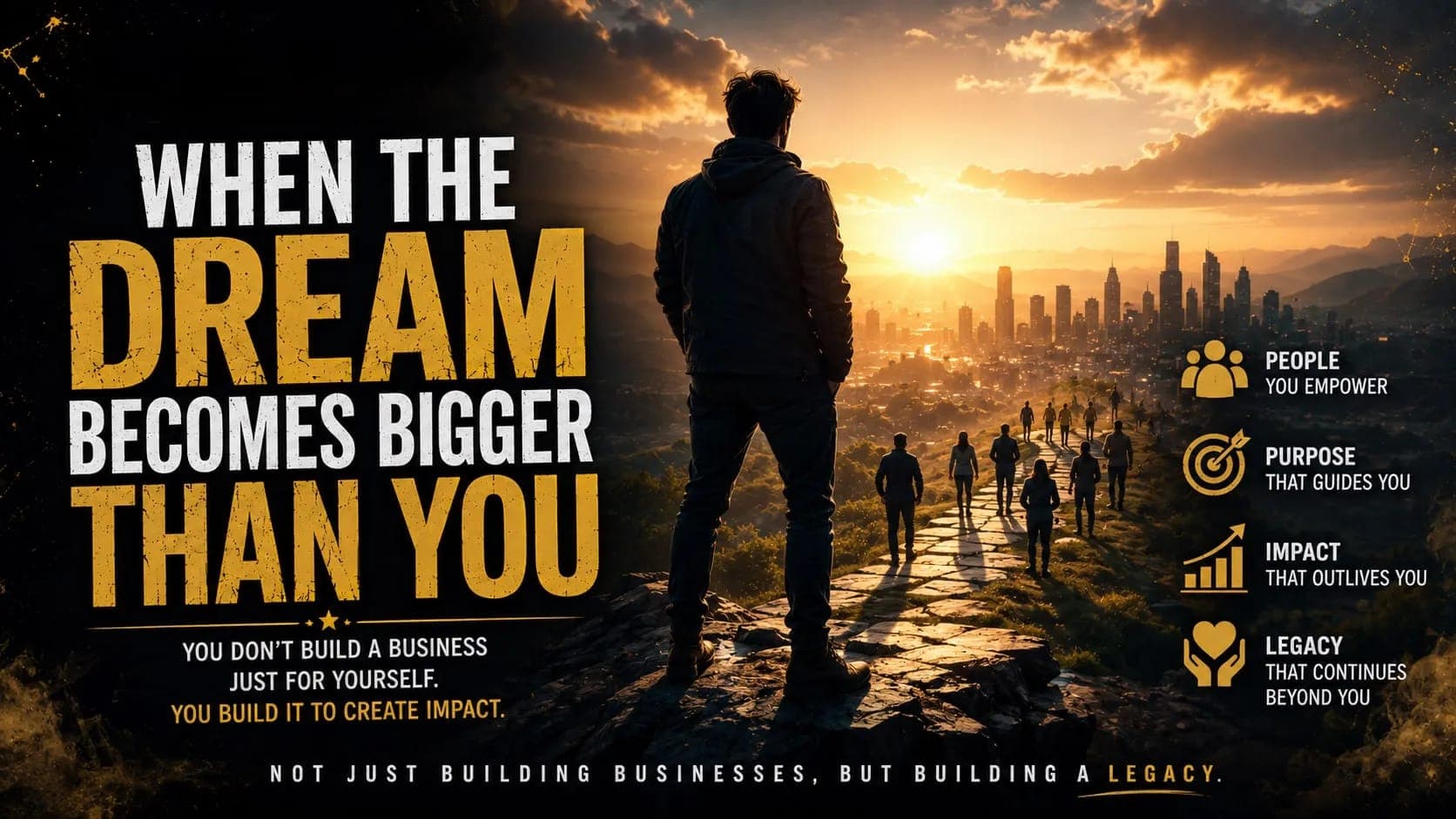
There is a moment in every entrepreneur's journey when the dream stops being just a dream. It becomes a responsibility.
In the beginning, it is simple. You have an idea. You have a picture in your mind of something that doesn't exist yet. You imagine the company, the product, the brand, the people, the possibilities. And you think about what it could become. At that stage, the dream belongs entirely to you. Nobody else can see it. Nobody else can feel it the way you do. Nobody else knows how many nights you have spent thinking about it. So you begin. You take the first step. Maybe it is small. Maybe nobody notices. Maybe you don't even know whether it will work.
But you start. And then something strange happens. The dream begins changing you. You start learning things you never thought you needed to learn. You learn about money. You learn about customers. You learn about failure. You learn about people. You learn about patience. You learn about rejection. You learn about responsibility.
You learn that an idea is easy to imagine but incredibly difficult to build. And slowly, you realize that entrepreneurship was never only about creating a business. It was also about creating the person capable of carrying that business.
The person who started the journey is not the same person who reaches the later stages. You become more patient. More disciplined. More observant. More comfortable with uncertainty. You learn to make decisions without having all the answers. You learn that failure doesn't always mean stop. Sometimes it means change direction. Sometimes it means learn. Sometimes it means begin again.
And eventually, if you keep going long enough, something else begins to happen. The business stops being only yours. Customers become part of it. Employees become part of it. Partners become part of it. People who believe in your work become part of it. The people working beside you begin carrying pieces of the vision. And suddenly, your dream has become bigger than the person who imagined it. That is a powerful moment.
Because when the dream becomes bigger than you, your responsibility changes. In the beginning, you can make decisions based entirely on yourself. You can take risks because the consequences belong mostly to you. But when other people depend on what you are building, your decisions carry different weight. Your employees have families. Your customers trust your company. Your partners invest their time. Your team invests years of their lives. And now your dream carries pieces of other people's dreams too. That is when entrepreneurship becomes more than ambition. It becomes responsibility.
And perhaps that is the moment when a founder truly begins to understand what they are building. Because success isn't simply about making something bigger. Bigger revenue. Bigger offices. Bigger teams. Bigger numbers. Bigger recognition. Those things can be useful.
But bigger does not automatically mean better. A company can become enormous and still have no meaning. A person can become wealthy and still feel empty. A brand can become famous and still stand for nothing. Growth without purpose is simply expansion.
The real question is: What are you expanding? What are you actually trying to create? Why does your business need to exist? What problem are you solving? Whose life are you making better? What would disappear if your company disappeared tomorrow? These questions are much harder than asking how to increase revenue. But they are also much more important.
Because money can tell you how much you earned. It cannot tell you why you built it. A valuation can tell you what something is worth financially. It cannot tell you what it means. A follower count can tell you how many people are watching. It cannot tell you whether you actually changed anyone.
And eventually, every entrepreneur has to decide what success means to them. Maybe it is financial freedom. Maybe it is creating jobs. Maybe it is solving a problem. Maybe it is giving your family a better life. Maybe it is building something your children can inherit. Maybe it is proving that an idea everyone rejected could actually work. Maybe it is changing an industry. Maybe it is simply creating something that makes people's lives a little better. There is no single definition. Your definition is yours. But you need one.
Because if you don't decide what success means to you, the world will decide for you. And the world's definition of success keeps changing. One year it is money. Then followers. Then fame. Then status. Then a bigger house. Then a bigger car. Then another milestone.
And suddenly, you spend your entire life reaching destinations you never actually wanted. Entrepreneurship can become dangerous when you start building for an audience instead of building for a purpose. There will always be someone richer. Someone bigger. Someone faster. Someone younger. Someone more successful.
If your happiness depends on being ahead of everyone else, you will never arrive.
Because there will always be another mountain. So don't build simply to win a race. Build something worth having when the race is over. That is where legacy begins. Legacy is not simply what people say about you after you are gone. Legacy is what continues because you were here. The people you helped. The opportunities you created. The businesses you built. The ideas you introduced. The problems you solved. The people you inspired. The leaders you developed. The lives that became better because your work existed. That is legacy.
And perhaps the most beautiful thing about legacy is that you don't always get to see its full impact. You may build something today that changes someone's life ten years from now. You may teach someone something they later teach another person. You may create a company that gives thousands of people opportunities you never imagined. You may build a product that becomes part of someone's everyday life. You may create an idea that inspires someone else to begin their own journey. You may never know all the people your work touches. That is the strange beauty of creating something meaningful. Its impact can travel farther than you ever will. And that is when the dream becomes bigger than you. It no longer depends on your presence. It begins living through other people. Your company can continue without you. Your ideas can continue without you. Your values can continue without you. Your people can continue building. And that should not frighten you. It should be the goal.
Because if everything disappears the moment you step away, then perhaps you didn't build something. Perhaps you only performed something.
A real business should eventually develop a life of its own. Systems. People. Culture. Principles. Knowledge. Trust. A purpose. Something that can continue moving even when the founder is no longer standing at the center.
This is why the greatest founders eventually stop asking: "How do I make this company depend on me?"
And start asking: "How do I make this company strong enough that it doesn't have to?" That is a completely different mindset. In the beginning, you are the business. Eventually, you build the business. And finally, you build something beyond the business. You build an institution. A culture. A community. A legacy.
But don't misunderstand the word legacy. Legacy doesn't mean becoming famous.
There are countless people whose names history will never remember who changed thousands of lives. A teacher who changed a student's future. A founder who gave someone their first opportunity. A business owner who kept hundreds of families employed. A creator who gave someone courage. A person who built something honest and meaningful without ever becoming famous. Legacy doesn't require an audience. It requires impact.
And that brings us back to the beginning. Why did you start? Before the company. Before the money. Before the team. Before the brand. Before the recognition.
There was something inside you that said: "I want to create this."
Maybe you couldn't explain it. Maybe you didn't have a perfect business plan. Maybe you didn't know how you would finance it. Maybe you didn't even know whether anyone would believe in you. But something inside you told you to begin. Never lose connection with that person.
Because success can sometimes make you forget why you started. You become so focused on growth that you forget the original purpose. You become so focused on competition that you forget the customer. You become so focused on numbers that you forget the people. You become so focused on the future that you stop living in the present. Remember the beginning. Remember the first customer. Remember the first payment. Remember the first failure. Remember the first person who believed in you. Remember the first time someone told you that your work made a difference. Those moments are worth more than they appear.
Because they remind you that a business is not built from numbers alone. It is built from moments. One customer. One decision. One problem solved. One person hired. One person helped. One opportunity created. One risk taken. One failure survived. One lesson learned. Then another. And another. And another.
Until years later, you look back and realize that the empire you see wasn't built in one extraordinary moment. It was built through thousands of ordinary moments. That is how almost everything meaningful is created. Slowly. Quietly. Consistently. And sometimes painfully. The world loves the final picture. Nobody sees all the unfinished sketches. People celebrate the company after it becomes successful. They don't see the empty office. The rejected proposals. The unanswered calls. The failed products. The nights of doubt. The decisions that didn't work. The sacrifices. The uncertainty.
But all of those things are part of the story. Don't be ashamed of them. They are not interruptions to the journey. They are the journey. And maybe that is the most important lesson Founder Mindset can leave you with. You don't need to know exactly where your journey will end. You need to know why you are willing to begin. You don't need to have everything figured out. You need the courage to learn. You don't need to become successful overnight. You need the patience to build. You don't need everyone to believe in you. You need enough belief to take the next step.
And you don't need to become someone else to build something great. You need to become more completely yourself. Understand your strengths. Accept your weaknesses. Discover your values. Find your purpose. Understand what you love. Understand what you are willing to sacrifice. Understand what you refuse to compromise. Then build from there.
Because the strongest businesses are not always built from the best ideas. They are often built from the deepest understanding of why the idea matters.
And perhaps your first business will fail. Perhaps your second will fail too. Perhaps you will change industries. Change ideas. Change teams. Change strategies. Change your entire direction. That's okay. The entrepreneur is not the company. The entrepreneur is the person who keeps learning how to create.
And as long as that person keeps learning, the story isn't over. You can lose money. You can lose a business. You can lose an opportunity. You can lose your reputation for a moment. You can even lose your confidence. But if you don't lose the ability to begin again, you haven't lost everything.
Sometimes the greatest comeback begins with the smallest decision: "I'll try again."
And perhaps one day you will stand inside something you once only imagined. You will look around. There will be people working because of the opportunity you created. Customers using something you built. A team carrying your values. A brand people recognize. A company that has become bigger than you. And in that moment, you may realize something.
The real achievement wasn't the building. It wasn't the money. It wasn't even the success. It was everything you had to become to get there. The impatient person learned patience. The fearful person learned courage. The inexperienced person gained wisdom. The person who once needed approval learned to trust themselves. The person who wanted to control everything learned to trust others. The person who only wanted to build a business discovered a purpose.
The entrepreneur became a person capable of creating something that could outlive them. That is when the dream becomes bigger than you. Not when the company becomes famous. Not when the numbers become impressive.
But when what you created begins creating value without requiring you to be everywhere. When other people carry the vision. When other people benefit from the opportunity. When other people grow because you decided to begin. When the idea that once lived only inside your mind becomes part of the real world. That is the moment you understand what building truly means. You weren't simply creating a company. You were creating possibility.
And maybe that is what every entrepreneur is really searching for. Not just success. Possibility. The possibility of a different life. The possibility of solving a problem. The possibility of creating something that didn't exist. The possibility of giving someone else an opportunity. The possibility of leaving the world slightly different from how you found it. You may not change the entire world. You don't have to.
Change the part of the world that you can reach. Build something useful. Create something beautiful. Solve something meaningful. Give someone an opportunity. Teach someone what you learned. Build something honest. And if enough people do that, the world changes one small piece at a time.
So if you are standing at the beginning of your entrepreneurial journey right now, don't worry about becoming an empire tomorrow. Don't worry about becoming famous. Don't worry about having everything figured out. Start. Learn. Fail. Adjust. Build. And then build again. Find people who believe in what you're creating. Build something that can survive without your constant presence. Protect your purpose. Keep learning. And never forget why you began.
Because one day, the thing you started as a small idea may become something much larger than you ever imagined. And when that happens, don't ask only: "How big did I become?"
Ask: "How much good did this dream create?" That is a better measurement.
Because at the end of your journey, people may forget your revenue. They may forget your office. They may forget your awards. They may forget how many employees you had. But they will remember how your work made them feel. They will remember the opportunities. They will remember the people you helped. They will remember the things you created. They will remember the courage it took to begin.
And perhaps that is the greatest definition of success. To build something that continues to create value after you stop building it. To create something that gives more than it takes. To leave people stronger than you found them. To leave an idea in the world that continues moving after you are gone. That is when a business becomes more than a business. That is when a dream becomes more than a dream. That is when your work becomes part of something larger than yourself.
And that is when you finally understand: The goal was never to become bigger than everyone else. The goal was to build something bigger than yourself. The End of Founder Mindset
Maybe we started this journey asking: "How do I become an entrepreneur?" But perhaps that was never the real question.
The real question was: "Who do I need to become to build the life, the business, and the legacy I believe in?" And there may never be a final answer. Because you will keep changing. Keep learning. Keep building. Keep becoming. And maybe that's the real meaning of the entrepreneurial journey. It never truly ends. The company may change. The dream may evolve. The destination may move.
But the mindset remains: Think. Begin. Learn. Build. Fall. Rise. Evolve. Create.
And then, one day, turn around and realize that the person who once dreamed about changing their life has become someone capable of changing the lives of others. That is the journey. That is the Founder Mindset. And this is only the beginning.
"A dream is born inside one person, but its greatest purpose is to become something that can live, grow, and create meaning long after that person has taken the first step."
— K.S. Lakhotia