
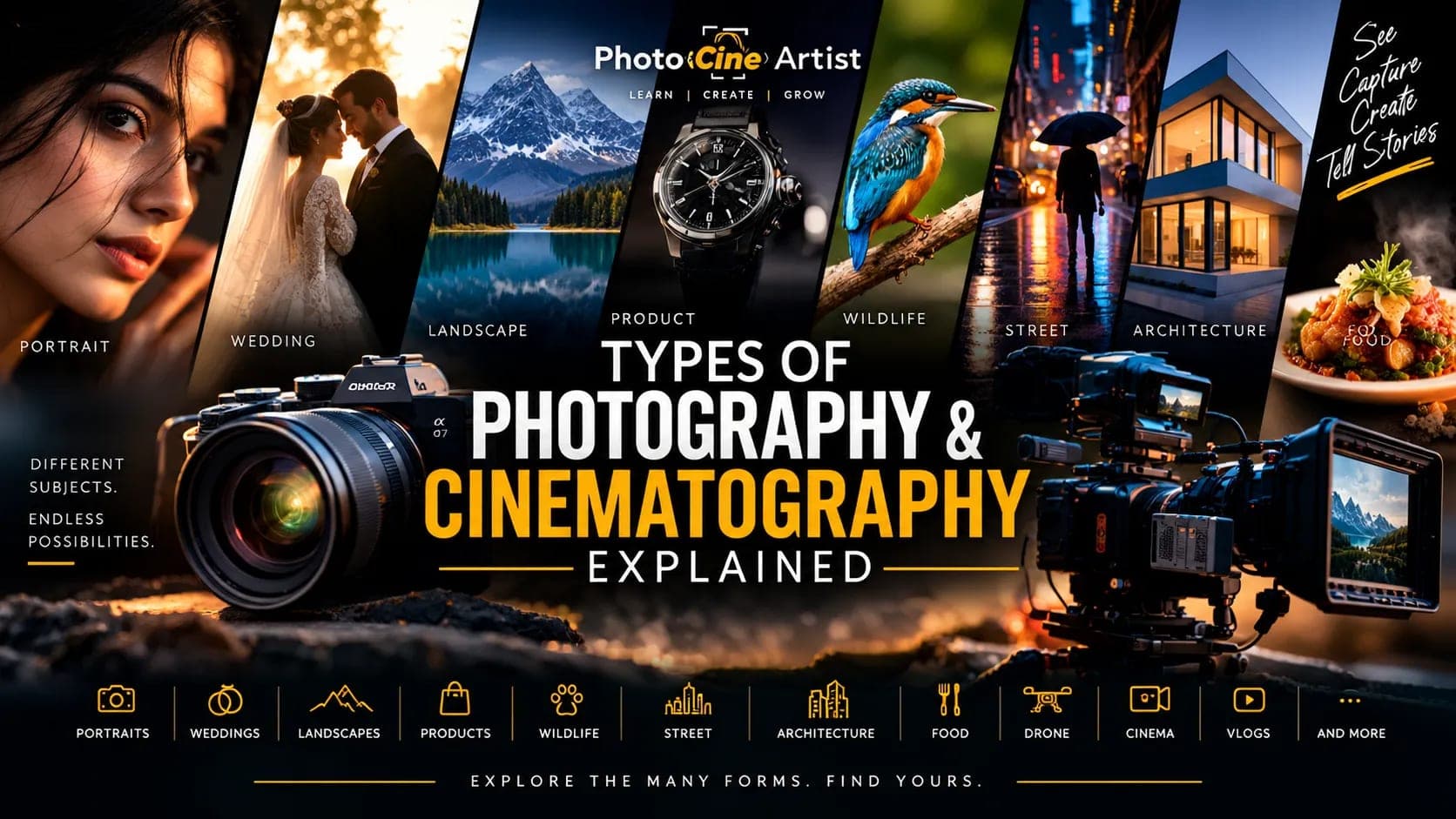
There is no single way to photograph the world.
There is no single way to tell a story through a camera.
The same camera can photograph a wedding in the morning, a product in the afternoon, a mountain at sunset and a cinematic advertisement at night.
The instrument may remain the same.
The vision changes.
Photography and cinematography are not single professions with fixed boundaries. They are vast creative worlds, each containing its own languages, techniques, emotions and purposes.
Some images are created to preserve memories.
Some are created to sell.
Some are created to inform.
Some are created to inspire.
Some are created simply because the artist saw something beautiful and could not walk past it without capturing it.
This is what makes the visual arts so fascinating.
There are countless ways to see the world—and therefore countless ways to capture it.
---
Photography Is a Universe of Perspectives
Photography began with the desire to preserve what the human eye could see.
Over time, that simple idea developed into hundreds of specialised disciplines.
The difference between them is not always the camera.
It is the subject.
The purpose.
The environment.
The light.
The moment.
And most importantly, the intention behind the photograph.
A portrait photographer searches for personality.
A landscape photographer searches for scale.
A street photographer searches for life.
A product photographer searches for perfection.
A documentary photographer searches for truth.
The subject changes.
The way of seeing changes with it.
---
Portrait Photography
A portrait is more than a photograph of a face.
A face can tell a story that words may struggle to express.
A portrait photographer therefore learns to observe expressions, posture, gestures, eyes, light and silence.
The background matters.
The clothing matters.
The direction of light matters.
But the person matters most.
A technically perfect portrait can still feel empty if it does not reveal something about the person standing in front of the camera.
The strongest portraits often feel less like photographs and more like conversations without words.
Portrait photography can include personal portraits, professional headshots, editorial portraits, celebrity portraits, corporate portraits and creative conceptual work.
---
Wedding Photography
A wedding is not a single event.
It is thousands of small moments happening around one major moment.
The exchange of glances.
A nervous smile.
Parents watching their children begin another chapter.
Friends laughing.
Hands holding hands.
A tear being quietly wiped away.
The ceremony is important.
But everything happening around it is important too.
Wedding photography therefore combines portraiture, documentary photography, event photography, fashion, architecture and storytelling.
The photographer must be prepared for everything because real moments rarely wait for perfect camera settings.
---
Fashion Photography
Fashion photography lives somewhere between reality and imagination.
The clothes are real.
The environment may be designed.
The lighting can be dramatic.
The pose can be theatrical.
The final photograph may represent not simply what someone is wearing, but what a brand wants people to feel when they see it.
Fashion photography is therefore closely connected to identity.
Luxury.
Youth.
Power.
Elegance.
Rebellion.
Culture.
Minimalism.
The photographer becomes part photographer, part director and part visual storyteller.
---
Product Photography
A product cannot explain itself.
A photograph often has to do that job.
A watch needs to look precise.
A smartphone needs to look sophisticated.
A piece of jewellery needs to communicate detail.
Food needs to look appetising.
A car needs to communicate performance and lifestyle.
Product photography therefore requires extraordinary attention to detail.
Reflections.
Textures.
Edges.
Shadows.
Colours.
Materials.
Every small element can influence how the product is perceived.
In commercial photography, beauty has a purpose.
The photograph must make the viewer understand why the object matters.
---
Food Photography
Food photography transforms taste into sight.
The viewer cannot smell the food.
They cannot touch it.
They cannot taste it.
Yet a photograph attempts to make them imagine all three.
Steam rising from a dish.
The texture of bread.
The shine of sauce.
Fresh ingredients.
Warm natural light.
Carefully arranged composition.
Food photography is therefore an exercise in visual temptation.
It is not merely about photographing what is on the plate.
It is about creating the desire to reach for it.
---
Architecture and Interior Photography
Buildings have personalities too.
Some are bold.
Some are quiet.
Some are futuristic.
Some carry history.
Architecture photography captures these personalities through lines, geometry, perspective, texture and light.
Interior photography goes deeper.
It communicates how a space feels.
A bedroom can feel peaceful.
A restaurant can feel luxurious.
An office can feel energetic.
A home can feel warm.
The photographer is not simply documenting walls and furniture.
They are photographing space as an experience.
---
Landscape Photography
Landscape photography teaches patience.
The mountain does not move for the photographer.
The river does not change its course because someone arrived with a camera.
The photographer must wait.
For light.
For clouds.
For weather.
For atmosphere.
For the right moment.
A landscape photograph can turn a geographical location into an emotional experience.
It can make a person feel small beneath a mountain.
Peaceful beside a lake.
Curious beneath a night sky.
Landscape photography reminds us that sometimes the greatest creative decision is simply knowing when to wait.
---
Wildlife Photography
Wildlife photography demands patience, preparation and respect.
The subject cannot be directed.
There are no retakes.
There is no second take because the animal moved at the wrong moment.
The photographer must observe behaviour.
Understand distance.
Anticipate movement.
Respect the environment.
And remain ready.
A bird taking flight may last only a fraction of a second.
A predator may appear for a moment and disappear again.
Wildlife photography therefore teaches one of the most valuable lessons in visual storytelling:
Preparation allows spontaneity to become art.
---
Street Photography
The street is perhaps the world's largest uncontrolled studio.
Nobody is posing for you.
Nobody is waiting for the perfect frame.
Life simply happens.
A man crossing a road.
A child laughing.
An old couple walking together.
A shopkeeper opening his store.
Rain reflecting city lights.
A stranger standing alone beneath a street lamp.
Street photography finds stories inside ordinary life.
It teaches the photographer to notice what others have learned to ignore.
---
Travel Photography
Travel photography combines geography with human experience.
It is not only about photographing famous monuments.
The most memorable travel images often contain small details.
A local market.
A traditional meal.
A roadside conversation.
A quiet street.
A local craft.
A child's expression.
A train disappearing into the landscape.
Travel photography becomes powerful when the photographer stops trying to prove that they visited a place and starts trying to understand the place.
---
Documentary Photography
Documentary photography exists closer to reality than imagination.
It records people, communities, cultures, events and circumstances.
The photographer becomes an observer.
Sometimes the subject is beautiful.
Sometimes it is difficult.
Sometimes it is uncomfortable.
The responsibility is to represent the story with honesty and sensitivity.
A documentary photograph may eventually become more than an image.
It can become a historical record.
---
Photojournalism
Photojournalism operates at the intersection of photography and news.
The photograph becomes part of public information.
Political events.
Natural disasters.
Wars.
Sports.
Protests.
Celebrations.
Human-interest stories.
The photojournalist works under pressure, often with very little control over the environment.
The objective is not to create an artificial reality.
It is to capture reality as it unfolds.
In photojournalism, timing can be everything.
A fraction of a second can separate an ordinary photograph from an image that defines an entire event.
---
Sports Photography
Sports photography is photography at the speed of life.
A runner crosses the finish line.
A footballer strikes the ball.
A cricketer celebrates.
A boxer reacts.
A player falls.
A crowd erupts.
Every moment disappears almost instantly.
The sports photographer must anticipate what is about to happen rather than simply react after it happens.
Fast shutter speeds, long lenses, autofocus systems and positioning become important.
But technical ability alone is not enough.
The photographer must understand the sport.
Because sometimes the best photograph happens before the victory.
---
Astrophotography
There is another world above us.
Astrophotography attempts to bring it closer.
Stars.
Planets.
The Milky Way.
The Moon.
Nebulae.
The night sky reminds photographers that light does not always come from nearby.
Sometimes it has travelled across unimaginable distances before reaching the camera.
Astrophotography combines photography with science, patience and technical precision.
It is one of the clearest examples of how photography allows humans to see beyond ordinary human vision.
---
Macro Photography
The smaller the subject, the larger the world can become.
A flower petal.
An insect's eye.
A drop of water.
The texture of a leaf.
A tiny mechanical component.
Macro photography reveals details that normally disappear into everyday vision.
It changes scale.
Something insignificant becomes extraordinary.
And in doing so, macro photography teaches a beautiful principle:
Wonder does not always require something large. Sometimes it requires looking closer.
---
Cinematography Begins Where Photography Starts Moving
Photography captures a moment.
Cinematography connects moments.
But cinematic storytelling contains many worlds of its own.
Narrative films.
Documentaries.
Commercials.
Music videos.
Corporate films.
Short films.
Web series.
Travel films.
Event films.
Educational films.
Social-media videos.
Vlogs.
Each requires a different visual language.
---
Narrative Cinematography
Narrative filmmaking is the world most people traditionally associate with cinematography.
Characters.
Conflict.
Emotion.
Dialogue.
Environment.
Time.
The cinematographer works closely with the director to create a visual language for the story.
A dark room may create tension.
A wide landscape may create freedom.
A close-up may reveal intimacy.
Camera movement may create energy.
A static frame may create isolation.
The cinematographer is therefore not simply recording actors.
They are helping build the emotional world in which the story exists.
---
Documentary Cinematography
Documentary cinematography works differently.
Reality cannot always be controlled.
People may behave differently when cameras arrive.
Events may unfold unexpectedly.
Weather can change.
Locations can become unavailable.
The cinematographer must remain flexible.
Observation becomes essential.
The goal is often to create cinematic images without losing the authenticity of the real world.
---
Commercial Cinematography
Advertising cinematography combines storytelling with business objectives.
A commercial may have only a few seconds to communicate an idea.
Every frame therefore needs purpose.
The lighting, camera movement, lens, colour, production design and editing must work together.
The viewer may remember the emotion before remembering the product.
That is precisely why commercial cinematography is powerful.
It sells an idea before it sells an object.
---
Music Video Cinematography
Music videos occupy a unique space.
The music already provides rhythm.
The visuals can therefore become more experimental.
Colour can change with the beat.
Camera movement can follow the music.
Editing can become rhythmic.
Performance can merge with narrative.
Reality can merge with imagination.
A music video does not always need to explain.
Sometimes it simply needs to make the audience feel.
---
Corporate Cinematography
Corporate filmmaking may appear formal from the outside, but it can contain powerful stories.
A company is ultimately made of people.
Their work.
Their challenges.
Their innovation.
Their culture.
Their vision.
Corporate cinematography translates those elements into a visual identity.
A corporate film can introduce a company, explain a product, document an event, communicate an achievement or tell the story behind an organisation.
The camera becomes a bridge between the business and the audience.
---
Event Cinematography
Events happen once.
That makes them impossible to recreate exactly.
Conferences.
Concerts.
Launches.
Weddings.
Award ceremonies.
Corporate gatherings.
Festivals.
The cinematographer must anticipate important moments while simultaneously capturing atmosphere.
The crowd.
The stage.
The speaker.
The reaction.
The lights.
The energy.
Event cinematography is therefore part documentation and part storytelling.
---
Travel Films and Vlogs
The modern creator has turned everyday experiences into cinematic stories.
A journey can become a film.
A business trip can become a story.
A morning routine can become a visual diary.
A simple conversation can become meaningful content.
Vlogging has demonstrated that audiences do not always need extraordinary events.
They often want authentic experiences.
The creator's personality becomes part of the story.
The camera becomes a companion rather than merely a recording device.
---
Mobile Cinematography
The most interesting camera may sometimes be the one already in your hand.
Modern smartphones can capture high-quality photographs and video, making visual storytelling accessible to almost everyone.
Mobile cinematography has created an entirely new generation of creators.
Students.
Entrepreneurs.
Travellers.
Artists.
Business owners.
Journalists.
Creators.
Anyone can begin.
But accessibility should never be confused with mastery.
The smartphone can give you the tool.
It cannot give you the eye.
---
Drone Cinematography
A drone changes the relationship between camera and space.
The camera can rise above a city.
Move through a landscape.
Follow a vehicle.
Reveal a location.
Circle a subject.
Travel over water.
The perspective itself becomes part of the story.
Drone cinematography has become valuable in filmmaking, real estate, tourism, advertising, weddings, documentaries and commercial productions.
It is another reminder that changing the camera's position can completely change the meaning of a scene.
---
One Artist, Many Worlds
A common mistake for beginners is believing that they must immediately choose one category.
They do not.
A photographer can begin with portraits and discover fashion.
A wedding photographer may discover documentary storytelling.
A filmmaker may discover commercial advertising.
A travel creator may discover cinematography.
A product photographer may eventually become a creative director.
The disciplines are connected.
They borrow from one another.
They influence one another.
They evolve together.
The important thing is not to decide your entire future on the first day.
It is to explore enough worlds to discover where your vision feels most alive.
---
Finding Your Visual Language
Eventually, every serious photographer and cinematographer begins asking a deeper question.
Not:
“What should I shoot?”
But:
“What do I want my work to say?”
That is where a career begins to become an artistic identity.
Your favourite subjects.
Your relationship with light.
Your composition.
Your colour.
Your camera movement.
Your treatment of people.
Your sense of timing.
Your emotional choices.
All of these gradually form something unique.
Your visual language.
And visual language is not discovered overnight.
It is built frame by frame.
---
The Camera Is Only the Beginning
There will always be discussions about cameras.
Which sensor?
Which lens?
Which resolution?
Which frame rate?
Which stabiliser?
Which drone?
Which lighting system?
Technology matters.
But equipment cannot replace observation.
A better camera can produce a technically better image.
A better artist can produce a more meaningful one.
That distinction is at the heart of the PhotoCine Artist philosophy.
Learn the equipment.
Understand the technology.
Master the technique.
But never stop developing the eye behind the camera.
---
The World Is Your Studio
A studio can be a room.
A street can be a studio.
A mountain can be a studio.
A restaurant can be a studio.
A factory can be a studio.
A wedding can be a studio.
A smartphone can be a camera.
A conversation can become a story.
The world itself is full of subjects.
The only requirement is the willingness to look.
Photography and cinematography offer something rare in a rapidly moving world:
the ability to stop, observe and give meaning to a moment.
And perhaps that is why there are so many forms of visual storytelling.
Because human life itself has so many forms.
We photograph people.
Places.
Products.
Cultures.
Dreams.
Businesses.
Memories.
We film journeys.
Stories.
Ideas.
Emotions.
Movements.
Lives.
Different fields.
Different techniques.
Different purposes.
Yet beneath them all is one common language:
the language of seeing.
The PhotoCine Artist does not need to master every category.
But they should explore enough of them to understand what kind of storyteller they want to become.
Because eventually, the question is no longer about choosing between photography and cinematography.
It is about discovering your way of seeing the world.
Shoot for Life.
Create with Passion.
Build Your Career.
And wherever your camera takes you, remember—the world is not short of things to capture. It is waiting for someone who knows how to see them.
“There may be countless ways to capture the world, but the journey of a PhotoCine Artist begins when you discover the way you want the world to be seen through your eyes.”