
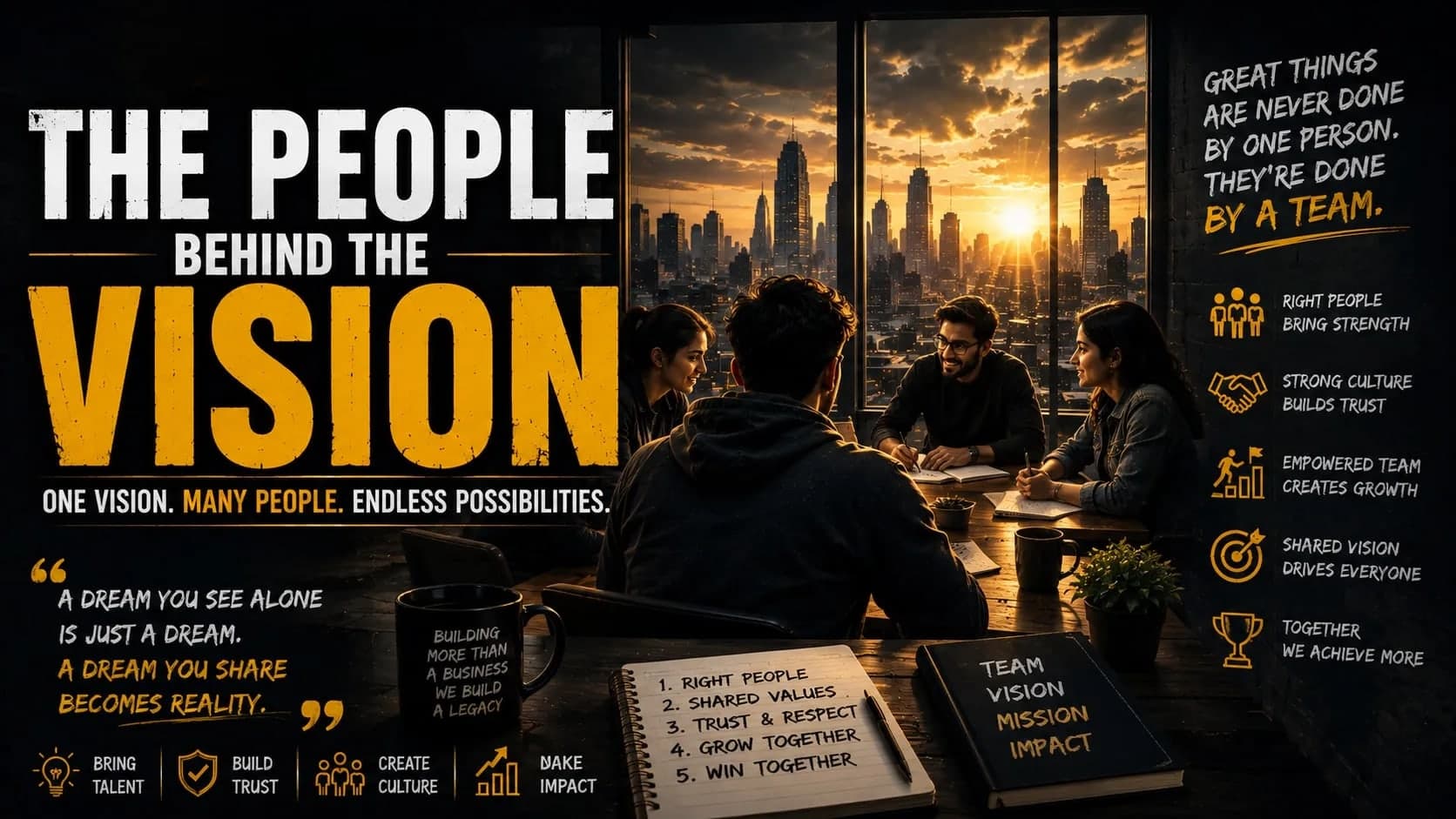
Every great vision begins in one person's mind.
A thought.
An idea.
A dream of creating something that doesn't exist yet.
In the beginning, it may belong entirely to you. You think about it when you wake up. You think about it while you work. You think about it before you sleep. You see the future of something that nobody else can see yet.
And because the vision was born inside you, you naturally believe that you have to carry everything yourself. You become the salesperson. The strategist. The marketer. The accountant. The designer. The problem solver. The person answering the phone at midnight. The person fixing mistakes. The person making every important decision.
At the beginning, this may be necessary. But eventually, something changes. Your vision becomes too large for one person to carry. And this is where many entrepreneurs face one of the hardest lessons of building a business: You cannot build something truly big by yourself. You can start alone. You can struggle alone. You can even succeed alone for a while.
But if your dream is bigger than your own capacity, eventually you need people. Not just employees. People. People with their own dreams. Their own talents. Their own experiences. Their own weaknesses. Their own ambitions.
And perhaps most importantly, their own reasons for believing in what you are building.
Because there is a huge difference between having people work for your company and having people believe in your company.
An employee may complete a task because it is their job. A committed person may complete it because they understand why it matters.
One follows instructions. The other understands the mission. And that difference can completely change an organization.
Hire the Person, Not Just the Skill
When you are building a team, don't simply ask: "What skills does this person have?"
Ask: "What kind of person are they?"
Because skills can be learned. Experience can be developed. Knowledge can be acquired.
But attitude, integrity, responsibility and character are much harder to manufacture. You can teach someone how to use software. You can teach someone your process. You can train someone to understand your product.
But teaching someone to care when nobody is watching is much harder. And that is why character matters. The person you hire may be talented. But are they responsible? Can you trust them? Can they admit when they make a mistake? Can they communicate honestly? Can they handle pressure? Can they respect customers? Can they respect their colleagues? Can they learn? Can they accept criticism?
Can they take responsibility without constantly looking for someone to blame?
These qualities may never appear on a résumé.
But they can determine the future of your company.
Your Company Is a Reflection of Its People
Because eventually, your business becomes a reflection of the people inside it. You can create the best policies. You can create the most beautiful office. You can build impressive systems.
But if the people operating them don't care, none of it matters.
A company is not its building. It is not its website. It is not its logo. It is not its equipment.
A company is ultimately a group of people trying to create something together.
And the quality of those people determines the quality of what they create.
Hiring Is Adding to a Story
This is why hiring should never be treated as simply filling a vacancy. You are not just filling a chair. You are adding a person to the story of your company. And every person changes that story. Some people bring knowledge. Some bring creativity. Some bring discipline. Some bring leadership. Some bring relationships. Some bring energy.
Some bring a completely different way of looking at a problem.
And sometimes the best person you can hire isn't someone who thinks exactly like you.
It is someone who sees what you cannot.
Because if everyone in your company thinks exactly like you, you don't have a team. You have an echo. And an echo cannot challenge you. A good team should sometimes disagree.
Someone should be able to say: "I don't think this is the right decision."
Someone should be able to ask: "Why are we doing this?"
Someone should be able to point out a weakness in your plan. And as a founder, you have to learn how to hear those things without taking them personally.
Because criticism of an idea is not necessarily criticism of you.
Sometimes the person challenging your idea is protecting the company from a mistake.
That is valuable.
A founder who surrounds themselves with people who always say yes may feel powerful.
But they are often becoming weaker. You don't need people who worship your ideas. You need people who help improve them.
You need people who can look at your vision and say: "Here is how we can make it better." That is what a real team does. It doesn't simply follow the founder. It strengthens the founder.
Trust Is the Foundation of a Team
But building that kind of team requires trust. And trust is difficult. Especially for founders.
Because in the beginning, you did everything yourself. You know exactly how things should be done. You know every customer. You know every detail. You know every process. Then you hire someone.
And suddenly, they do something differently.
Your first instinct may be: "That's not how I would do it." And maybe you're right.
But that doesn't automatically mean they are wrong. There is a difference between maintaining standards and controlling every action.
If you want people to grow, you have to give them room to think. You have to allow them to make decisions. You have to allow them to make small mistakes. You have to let them discover their own strengths.
Because if every decision has to come back to you, you haven't built a team.
You have built a group of people waiting for permission. And that becomes dangerous as the company grows. Imagine having one hundred employees and every decision still needs the founder's approval. The founder becomes the bottleneck. Everything waits. Customers wait. Projects wait. Employees wait. Opportunities wait.
And eventually, growth becomes limited by one person's capacity.
Delegation Is Not Just Giving Away Work
This is why delegation is not about giving away work. It is about giving away responsibility. There is a difference.
If you tell someone: "Do this exactly the way I tell you." You are delegating a task. If you tell them: "This is the outcome we need. Find the best way to achieve it." You are delegating responsibility. The second creates ownership. And ownership creates leaders. That is what a growing company needs. Not hundreds of people waiting for instructions. People who can think. People who can solve. People who can take responsibility. People who can make decisions. People who can lead others.
Because eventually, your greatest achievement as a founder may not be the product you created. It may be the leaders you developed. Think about that.
Build an Organization, Not a Job
If you build a company where everything depends on you, you have built yourself a job.
If you build a company where capable people can make decisions without you, you have built an organization. That is a major difference. And it requires humility.
You have to accept that someone else may be better than you at something. Maybe someone can sell better than you. Maybe someone can manage people better than you. Maybe someone understands finance better than you. Maybe someone can design better than you. Maybe someone understands technology better than you. Maybe someone can communicate better than you. That isn't a threat. It is an advantage.
You don't need to be the best person in every department. You need to find the best people for those departments. Your job as a founder is not to compete with your team. Your job is to build a team that makes the company stronger.
And when you find someone better than you at something, don't feel smaller. Feel lucky.
Because you just discovered a capability your company didn't have before.
Money Matters, but It Isn't Everything
But people don't give their best simply because they receive a salary. Money matters. Of course it does. People have responsibilities. People have families. People have financial goals. Fair compensation is important.
But money alone doesn't create commitment. If it did, every highly paid employee would be deeply passionate about their company. They aren't.
People also want respect. Growth. Recognition. Purpose. Autonomy. Learning. Belonging.
They want to feel that their work matters.
They want to feel that they are more than a number on a payroll.
Leadership Is Different from Management
And this is where leadership becomes different from management.
A manager may ask: "Did you complete the task?"
A leader may ask: "Do you understand why this task matters?"
A manager focuses on output. A leader develops people. A manager tells people what to do. A leader teaches people how to think. A manager may control. A leader creates ownership.
And if you want to build something that lasts, you eventually have to become a leader. Not because the title says so.
But because people are following you. Whether you realize it or not, your behaviour teaches your team.
If you arrive late, they learn that time doesn't matter.
If you treat customers disrespectfully, they learn that customers don't matter.
If you blame people for every mistake, they learn to hide mistakes.
If you admit your mistakes, they learn accountability.
If you stay calm during difficult situations, they learn composure.
If you keep your promises, they learn integrity.
Your team watches what you do far more closely than what you say.
Culture Begins with the Founder
That is why culture begins with the founder.
You cannot demand values from people that you refuse to practice yourself. If you want honesty, be honest. If you want discipline, be disciplined. If you want respect, show respect. If you want ownership, take ownership. If you want people to learn, keep learning yourself. Your company will absorb your behaviour. And over time, that behaviour becomes culture.
Culture is one of those invisible things that can become incredibly powerful.
You cannot always see it. But you can feel it. You can feel it when people walk into an office. You can feel it in meetings. You can feel it in how people talk to each other. You can feel it when something goes wrong. You can feel it in how a new employee is welcomed. You can feel it when someone succeeds. And you can feel it when someone fails. A healthy culture doesn't mean everyone is always happy. It means people know what is expected. They know they can speak. They know mistakes can be discussed. They know good work will be recognized. They know accountability exists. They know respect matters. They know the mission matters. And most importantly, they know they are part of something. That feeling can become incredibly powerful.
Because when people feel that they are building something rather than simply working somewhere, their relationship with the company changes. They begin protecting the reputation. They begin thinking beyond their individual task.
They begin asking: "How can we make this better?" And that question is priceless.
Not Everyone Has to Share Your Dream
But don't expect everyone to believe in your vision. Some people will simply want a job. And that's okay. Not everyone has to be emotionally connected to your dream. Some people may be there for a particular stage of their career. Some may want experience. Some may want stability. Some may eventually move on. That doesn't make them bad employees.
Your responsibility is to create an environment where people can contribute meaningfully while they are with you.
But you also have to understand that not everyone belongs in your organization.
This is one of the hardest lessons for founders. Sometimes you hire someone with great skills but poor attitude.
Sometimes someone who was excellent six months ago no longer fits the company's direction.
Sometimes a person's values don't match the culture. Sometimes someone consistently creates conflict. And sometimes you have to let people go. It doesn't necessarily mean they are bad people. It may simply mean the relationship no longer works.
A founder who is afraid to make those decisions can damage an entire team.
Because keeping the wrong person can sometimes be unfair to the right people. Your best employees notice. They notice when someone doesn't work. They notice when someone behaves badly.
They notice when someone repeatedly escapes accountability.
And if nothing happens, they eventually ask themselves: "Why should I care?" Fairness matters.
Leadership sometimes means making difficult decisions that nobody wants to make. But there is another side to this.
Never Forget Humanity
Don't become so obsessed with performance that you forget humanity.
Your employees are human beings. They have difficult days. They have families. They have fears. They have ambitions. They make mistakes. They get tired. They experience things you may know nothing about. You don't need to lower standards.
But you can maintain standards while still treating people with dignity. There is strength in demanding excellence. There is also strength in understanding people. The best leaders know the difference between someone who doesn't care and someone who is struggling. One needs accountability. The other may need support. Leadership is understanding which is which.
The Greatest Responsibility Is Helping People Grow
And sometimes, your greatest responsibility isn't telling people what to do.
It is helping them discover what they can become. Imagine joining a company as a junior employee and, five years later, becoming a department head. Imagine learning under someone who believed in your potential before you believed in yourself.
Imagine becoming a leader because someone gave you your first opportunity.
That is how organizations create more than revenue. They create people.
And those people eventually create more people. One leader develops another. That leader develops another.
And suddenly, the founder's influence spreads far beyond their direct involvement.
That is how a culture becomes bigger than an individual. And perhaps that is one of the most beautiful things about building a company.
From One Vision to Many
You may start with an idea that belongs only to you. But eventually, it becomes shared.
Someone else starts saying: "Our company."
Not: "Your company."
That single word can tell you how far you've come. Because the ultimate goal isn't to make everyone work for your dream.
It is to create a vision that people can make their own. That doesn't mean losing control of your company. It means creating ownership within it. You provide the direction. They help create the road. You define the values. They bring those values into their work. You establish the mission. They help carry it forward.
And eventually, the company becomes something bigger than the person who started it. That is when a founder begins transitioning into something greater.
From being the person who does everything— to becoming the person who creates the environment where everything can happen. That is leadership.
The Art of Letting Go
And leadership requires another difficult skill: letting go.
You have to let go of doing everything.
Let go of controlling every detail.
Let go of needing every decision to be yours.
Let go of the belief that nobody can do it as well as you.
Maybe nobody will do it exactly like you.
That's the point. You are not building copies of yourself. You are building a team. Different people. Different strengths. Different perspectives. Different personalities. But one direction.
A football team doesn't need eleven identical players. It needs different players who understand how to play together.
Business is similar.
You need different strengths working toward one goal. The creative thinker. The financial thinker. The salesperson. The strategist. The operator. The communicator. The technician. The leader. None of them can replace all the others.
But together, they can accomplish something none of them could accomplish alone. And that is the power of a team. One person can have a vision. A team can turn it into reality. One person can start the fire. A team can keep it burning.
The People Behind the Vision
And perhaps this is the real secret behind many great businesses. We celebrate founders. We put their names on magazine covers. We tell their stories. We talk about their decisions.
But behind almost every great company is a group of people whose names the world may never know. People who stayed late. People who solved problems. People who talked to customers. People who wrote code. People who delivered products. People who managed finances. People who built systems. People who trained others. People who believed when things were difficult.
They are the people behind the vision. And a good founder never forgets that.
Your employees are not simply resources. They are human beings contributing part of their lives to something you started. That is a responsibility. Treat it seriously. Pay fairly. Give credit. Create opportunities. Listen. Teach. Challenge. Protect your standards.
And when someone does something exceptional, make sure they know that you saw it. Recognition costs little.
But it can mean everything to the person receiving it. People remember how leaders made them feel. They remember who believed in them. They remember who gave them an opportunity. They remember who trusted them.
And they remember who took credit for their work. Choose which kind of leader you want to be remembered as.
Because eventually, your employees will become part of your legacy. Some may leave your company. Some may start their own businesses. Some may become leaders themselves. Some may carry lessons they learned from you for the rest of their lives.
And that means your influence may travel much further than your company.
A founder's legacy isn't only the company they leave behind. It is also the people they helped develop along the way.
Ask Better Questions
So when you build your next team, don't simply ask: "Who can help me build my business?"
Ask: "Who can grow with this business, and how can I help them grow?"
Don't ask only: "What can this person do for us?"
Ask: "What can we build together?"
That small change in thinking can transform the relationship between a founder and a team.
Because the strongest organizations are not built around one person shouting instructions from the top. They are built around shared belief. Shared responsibility. Shared standards. Shared purpose. And trust.
The founder provides the vision. The team gives the vision movement. And together, they create something that neither could create alone.
Every Organization Begins Somewhere
So if you are still working alone today, don't be ashamed of it. Every organization begins somewhere. Perhaps today, it is just you. Tomorrow, maybe one person joins you. Then another. Then another.
One day you have a small team. Then departments. Then managers. Then leaders.
And eventually, people you hired years ago are leading people you have never even met. That is growth.
Not simply because the number of employees increased.
But because your vision began living inside other people.
And when your vision can live inside other people, it can travel much farther than you ever could. That is the moment a business begins becoming an organization.
And perhaps one day, it becomes an institution. Something that doesn't depend entirely on one founder. Something that can survive changes. Something that can continue creating value. Something that can outlive the person who imagined it.
That is the true power of people. You may have the idea. You may have the courage. You may have the first step.
But if you want to build something that lasts, learn to build people as carefully as you build the business.
Because businesses grow through systems. Products grow through innovation. Brands grow through trust.
But organizations grow through people. And in the end, your greatest achievement may not be the size of your company.
It may be the number of people who became stronger because they were part of it. The people who found confidence. The people who discovered their talent. The people who became leaders. The people who learned to dream bigger.
The people who eventually went on to build something of their own.
That is a different kind of success. A deeper kind.
Because money can measure what your company earned. Revenue can measure what you sold. Growth can measure how large you became.
But people can measure what you changed.
And perhaps that is the question every founder should eventually ask:
"When people look back at the years they spent building with me, will they remember only the work—or will they remember becoming better because they were part of the journey?"
Build the company. Build the systems. Build the product. Build the brand. But above all— build the people who will carry the vision further than you ever could.
Because a vision carried by one person can become a business.
But a vision carried by many can become a movement.
"A founder may create the vision, but the people who believe in it are the ones who give it life; build your team well, and one day your dream will walk into the future without needing you to carry it."