
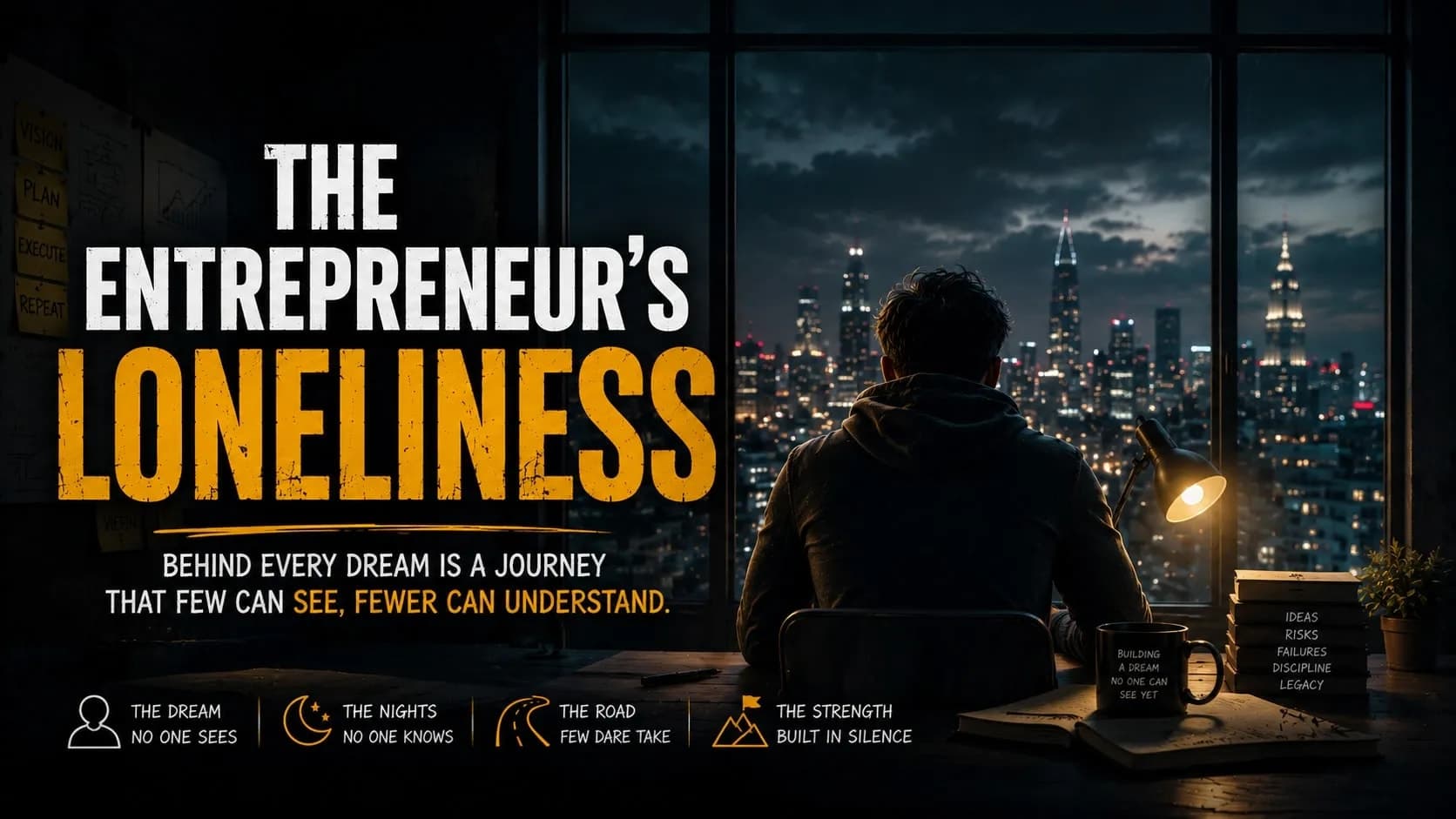
There is a side of entrepreneurship that nobody puts on the cover. We talk about success. We talk about money. We talk about freedom. We talk about building companies, creating teams, becoming successful and changing the world.
But somewhere behind all of that is a feeling that almost every entrepreneur experiences at some point. Loneliness.
Not necessarily the loneliness of having nobody around you. You can be surrounded by employees, clients, friends, family and people who support you—and still feel completely alone. Because sometimes loneliness isn't about having nobody beside you.
It is about having nobody who truly understands what is happening inside your mind.
When an idea first appears in your head, it belongs only to you. You can see something that doesn't exist yet. You can imagine a company that hasn't been built. You can imagine a product nobody has created. You can imagine a life that nobody around you can see.
And when you try to explain it, people may look at you and simply ask: "But how will that work?" They aren't necessarily trying to discourage you. They simply cannot see what you see. And that can be difficult.
Because the entrepreneur often has to believe in something before there is evidence that it will work. You may have an idea. But no customers. A plan. But no money. A vision. But no team. A dream. But no proof.
And still, you have to take the first step. That is one of the strangest things about entrepreneurship. You are expected to make decisions about a future that doesn't exist yet.
And sometimes, there is nobody who can tell you whether you are right. You can ask people for advice. You can study the market. You can research competitors. You can learn from experienced entrepreneurs.
But eventually, there comes a moment when the decision belongs to you.
And when you make it, you also have to accept the consequences. That responsibility can become heavy.
Because when you are an employee, a mistake may affect your work.
When you are a founder, a mistake can affect everyone's work. Your decision may affect your employees. Your customers. Your partners. Your investors. Your family. Your future.
And sometimes you have to make those decisions while secretly wondering whether you are making the wrong choice. That is the part people rarely see. They see confidence. They don't see doubt. They see ambition. They don't see exhaustion. They see the company. They don't see the nights spent questioning whether the company will survive. They see the result. They don't see the uncertainty that came before it.
This is why entrepreneurship can feel lonely even when you are surrounded by people.
Because there are thoughts you cannot always share. There are fears you don't always want to show. There are decisions you cannot simply hand over to someone else.
And there are moments when you have to become the strongest person in the room even when you don't feel strong yourself. Sometimes your team is looking at you for confidence. Your family is looking at you for stability. Your customers are looking at you for reliability.
And you are looking at yourself thinking: "I hope I can figure this out."
But you still have to walk into the room and say: "We'll figure it out."
That is leadership in its rawest form. Not pretending you know everything. But refusing to let uncertainty stop you from moving forward.
The Cost of Walking a Different Path
There will be moments when people around you won't understand why you are working so hard. They may see you missing weekends. They may see you declining invitations. They may see you spending money on something they don't understand.
They may ask why you are taking such risks. They may tell you to choose something safer. And sometimes they may be right. Not every risk is intelligent. Not every dream deserves to be pursued blindly.
But sometimes you know something about your own path that nobody else can know.
Because they are living their life. You are living yours. They have their definition of success. You have yours. They have their tolerance for risk. You have yours. They have their dreams. You have yours.
And that is why comparison can become dangerous. You cannot judge your journey using somebody else's map.
Maybe your friend is buying a house while you are reinvesting everything into your business. Maybe someone your age is earning more than you. Maybe someone who started after you is growing faster. Maybe someone who took a different path appears to be far ahead. But you don't know what their destination is. And they don't know yours.
Entrepreneurship teaches you something uncomfortable: You have to become comfortable walking a road that doesn't have many footprints. There may be no clear timeline. No guaranteed salary. No guaranteed promotion. No guaranteed success. You may work for years before anyone notices. You may build something that fails. You may start again.
The Power of Solitude
And sometimes, you may have to start again when everyone already believes you failed. That is where solitude becomes important.
Because being alone with your thoughts isn't always a weakness. Sometimes it is where clarity is born. When there is no noise. No notifications. No opinions. No competition. No audience. Just you and your thoughts. You begin asking questions that you avoided when life was busy.
Why am I doing this? What am I actually trying to build? Do I still believe in this? Am I pursuing a dream or trying to prove something? Do I want success—or do I want meaning? If nobody applauded me, would I still do this?
Those questions matter.
Purpose Beyond Validation
Because sometimes entrepreneurs don't realize that they stopped chasing a dream and started chasing validation. They want people to see them as successful. They want recognition. They want respect. They want to prove someone wrong. They want to show the people who doubted them that they were right. There is nothing wrong with using doubt as fuel for a while. But eventually, you need a deeper reason.
Because proving people wrong is a temporary motivation. Purpose can last a lifetime.
If the only reason you are building is to show someone what you can do, what happens when they stop watching? You need a reason that survives the applause. A reason that survives criticism. A reason that survives failure. A reason that belongs to you.
Sacrifice Without Self-Destruction
And perhaps that is why loneliness can sometimes become a strange teacher. It forces you to separate your own voice from everyone else's. You begin to understand what you actually want. Not what society tells you to want. Not what your friends want. Not what your family expects. Not what looks impressive on social media. But what you genuinely want to create with your life. That realization can be uncomfortable.
Because once you know what you want, you also know what you are willing to sacrifice for it. And every dream has a price. Time. Comfort. Security. Money. Relationships. Sleep. Certainty. Sometimes even your old identity. You cannot have everything at the same time. There will be seasons in life where you have to choose. And entrepreneurship often demands difficult choices. But sacrifice should not become self-destruction. This is another lesson founders have to learn.
Working sixteen hours every day doesn't automatically make you committed. Destroying your health doesn't prove ambition. Ignoring everyone you love doesn't prove dedication. And being permanently exhausted doesn't make you a better entrepreneur.
You are building a business to create a life—not to destroy the person living it. The goal isn't to become a machine. You are human. You need rest. You need relationships. You need moments where you don't think about work. You need silence. You need laughter. You need life outside the company.
Identity Beyond the Business
Because if your entire identity becomes your business, then every failure becomes a personal failure. And that can break you. You are not your revenue. You are not your company valuation. You are not your number of employees. You are not your followers. You are not your failures. You are not your successes. The business is something you build. It is not everything you are. That distinction becomes extremely important.
Because businesses can fail. Markets can collapse. Products can disappear. Partnerships can end. Companies can close. But you can begin again.
The entrepreneur has to understand that. Failure can take away a business. It does not have to take away your ability to build another one.
Sometimes the most valuable thing you gain from a failed business is the person you become afterward. You become more experienced. More aware. More disciplined. More realistic. More patient. You understand customers better. You understand money better. You understand people better. You understand yourself better.
And sometimes losing something teaches you more than winning ever could. That is why you should never allow one chapter to define your entire story. A failed business is a chapter. A bad decision is a chapter. A lost opportunity is a chapter. A difficult year is a chapter. Not the entire book.
Growth Changes Everything
But there is another kind of loneliness that comes with growth. Sometimes you outgrow the people around you. Not because you are better than them. But because your priorities change. The conversations that once excited you may no longer interest you. The things you once spent money on may no longer matter. Your definition of success may change. Your ambitions may become different.
And sometimes you find yourself sitting among people you have known for years and realizing that your lives are moving in completely different directions. That can hurt.
But growth often changes relationships. Some people will grow with you. Some people will support you from a distance. Some people will disappear.
And some people will only appear when you succeed. Learn the difference. Don't become bitter toward people who don't understand your journey. They aren't necessarily supposed to. Everyone has their own. You don't need everyone to understand you.
You need a few people who respect your journey even when they don't fully understand it. Those people are rare. Value them.
Because entrepreneurship can become much easier when you have even one person with whom you don't have to pretend.
Someone you can tell: "I'm scared." Without feeling weak.
Someone you can tell: "I don't know what I'm doing." Without feeling like a failure.
Someone who can remind you that you are a person before you are a founder. That matters.
Solitude vs. Isolation
Because sometimes the strongest thing an entrepreneur can do is admit that they are tired. Rest. Then continue. Not every battle needs to be fought today. Not every problem needs to be solved tonight. Sometimes the best strategic decision is simply to sleep and look at the problem again tomorrow. Your mind needs space.
And that is why solitude and isolation are not the same thing. Solitude is choosing to spend time with yourself. Isolation is feeling like you have nobody. Solitude can make you stronger. Isolation can slowly consume you. Learn to create solitude without creating isolation. Spend time alone. Think. Read. Walk. Write. Build. Reflect.
But don't disappear from the people who care about you. Entrepreneurship should not become an excuse to disconnect from life. Because one day, if the business becomes successful, you may look around and realize you have nobody to celebrate with. What would success mean then? A company can be rebuilt. Money can be earned again. Opportunities can return. But time doesn't. Relationships don't always return. Years don't come back.
So while you are building your future, don't completely abandon your present. Call your family. Meet your friends. Take a day off. Watch the sunset. Travel when you can. Sit somewhere without your laptop. Drink coffee without thinking about business. Laugh about something that has nothing to do with work. Live.
Because you are not building a company to escape life. You are building it to create a better life. Remember that.
Independence and Inner Confidence
And perhaps this is where the entrepreneur's loneliness becomes something else. It becomes independence. You learn that you don't need constant approval. You don't need everyone to agree. You don't need everyone to understand. You don't need applause every time you make a decision. You begin trusting your own judgment. Not blindly. But intelligently. You listen. You learn. You consider. And then you decide.
You become comfortable with your own company. You become comfortable with uncertainty. You become comfortable being misunderstood. You become comfortable starting before you have permission. And that creates a different kind of strength. Not arrogance. Not isolation. Inner confidence. The kind that doesn't need to announce itself.
You stop trying to convince everyone. You simply keep building. You stop explaining every move. You let results speak. You stop chasing every opportunity. You become selective. You stop fearing every failure. You start seeing failure as information. And slowly, you become the person your original dream required you to become.
The Company Builds You
Maybe that is the hidden gift of entrepreneurship. You start thinking you are building a company.
But somewhere along the way, the company starts building you. It teaches you patience. It teaches you courage. It teaches you responsibility. It teaches you humility. It teaches you resilience. It teaches you that people are complicated. It teaches you that money is important but not everything. It teaches you that time is more valuable than money. It teaches you that success without purpose feels empty. And it teaches you that nobody is coming to save your dream. At some point, you have to take responsibility for it.
That doesn't mean you have to do everything alone. It means you have to own your journey. Ask for help. Find mentors. Build friendships with people who understand entrepreneurship. Create a network. Find your tribe.
Because the strongest entrepreneurs aren't necessarily the ones who walk alone. They are the ones who know when to walk alone and when to walk with others. There is a difference between independence and refusing help. You can be independent and still ask for advice. You can be strong and still admit you need someone. You can lead and still listen. You can be ambitious and still be kind. You can be focused and still enjoy life. You don't have to become cold to become successful. You don't have to lose your humanity to build something extraordinary. In fact, protecting your humanity may be one of the most important things you do.
Remember Who You Were
Because eventually, your company may become bigger. Your team may grow. Your responsibilities may increase. Your name may become known. And the world may begin seeing the entrepreneur. But you should never forget the person who existed before the title. The person who had the dream. The person who was afraid. The person who started with almost nothing. The person who didn't know how it would work. The person who simply decided to try. Remember that person.
Because that person had something that success can sometimes take away: hunger. Stay hungry, but not desperate. Stay ambitious, but not obsessed. Stay confident, but not arrogant. Stay disciplined, but not cruel to yourself. Stay focused, but don't forget to live.
Walking the Road Alone
And when the journey becomes lonely, remember something important: You are not necessarily lost just because you are walking alone. Sometimes you are simply walking somewhere nobody else has walked before. There is a difference. The road may be quiet. There may be no audience. There may be no applause. There may be no guarantee.
But if you know why you are walking, you don't need the crowd to tell you where to go. Keep going. Learn. Adjust. Rest when necessary. Ask for help when necessary. And continue. Because one day, someone may walk the same road because you were brave enough to walk it first.
And that is when loneliness turns into leadership. Your private struggle becomes someone else's inspiration. Your failures become someone else's lessons. Your difficult years become someone else's roadmap. And your journey becomes proof that something impossible can become possible when someone is willing to begin.
Maybe that is what entrepreneurship really is. Not simply the ability to build something.
But the ability to believe in something before the world has a reason to believe. To stand alone when necessary. To listen when challenged. To change when wrong. To continue when tired. To begin again when broken. And to keep moving even when nobody is watching.
Because eventually, the people who once couldn't understand your vision may see the thing you were trying to build. And you may realize that you were never actually building alone. You were building yourself first. And that may have been the most important part of the journey.
"There will be moments when you have to walk alone, not because nobody believes in you, but because some roads can only be discovered by the person brave enough to take the first step."