
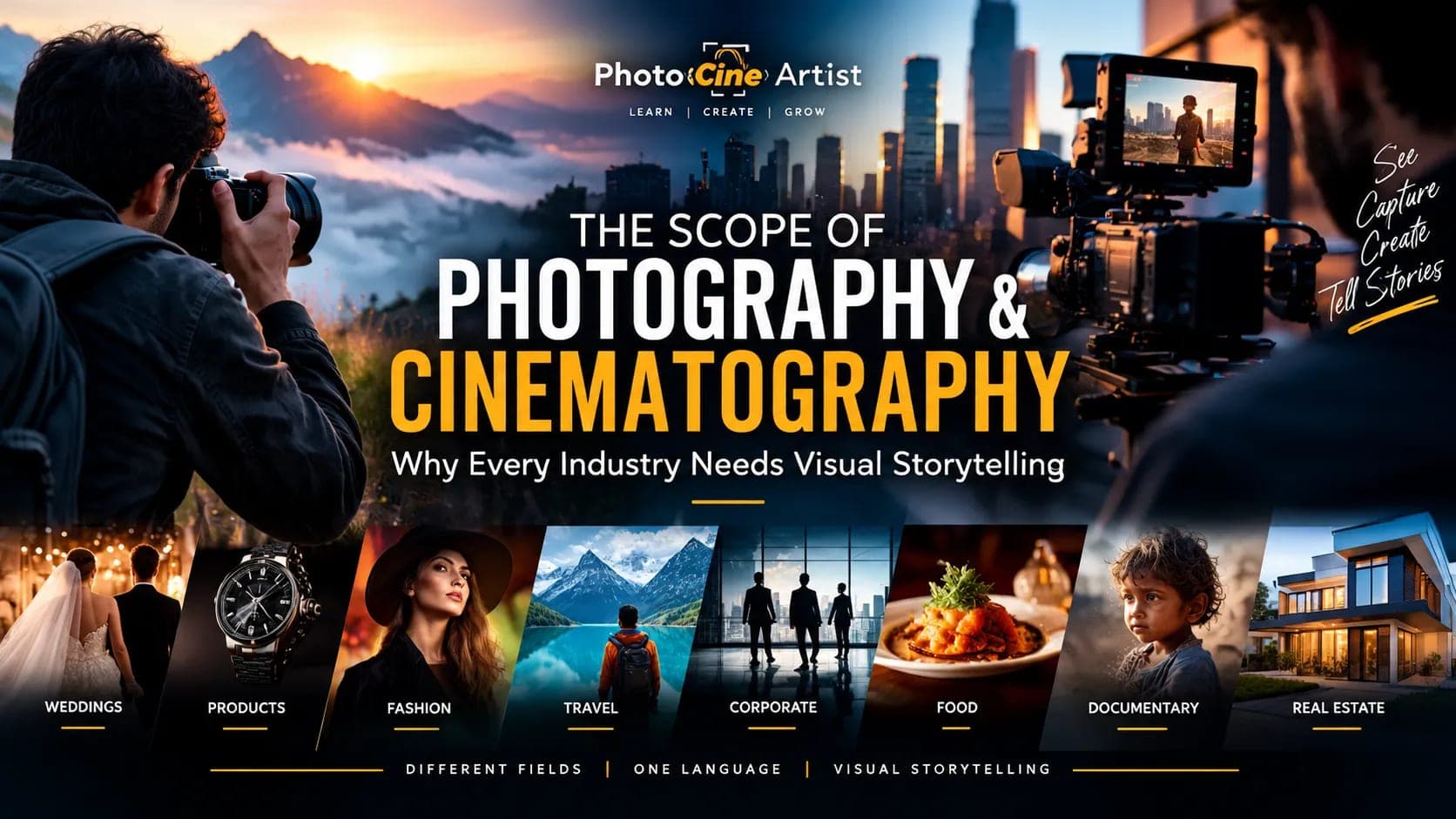
There was a time when a photograph was a luxury.
A moment had to be carefully prepared. A camera had to be brought out. People stood still, waited for the shutter, and preserved a fraction of their lives inside a physical frame.
Today, we live surrounded by cameras.
There is a camera in our pocket. A camera in our workplace. A camera above a doorway. A camera in a car, on a drone, inside a cinema rig and sometimes even on the smallest device we carry every day.
Yet the abundance of cameras has not reduced the value of photography and cinematography.
It has increased it.
Because the world does not need more images merely for the sake of having images.
It needs meaningful images.
It needs photographs that communicate.
It needs films that make people feel.
It needs visual stories that explain what words sometimes cannot.
And that is where the real scope of photography and cinematography begins.
---
Beyond the Camera
Photography is often mistaken for the act of pressing a shutter. Cinematography is often reduced to operating a camera. But the camera is only the instrument. The real profession begins before the camera is switched on. A photographer observes. A cinematographer interprets. A visual storyteller understands people, places, emotions, light, movement, timing and context. The camera simply becomes the medium through which that understanding reaches another person. This is why photography and cinematography have grown far beyond studios, weddings and films. They have entered almost every modern industry. ---Photography: The Art of Preserving Reality
A photograph freezes time. It takes something that existed for perhaps one second and gives it the possibility of existing for generations. A wedding photograph preserves a relationship. A product photograph communicates an object. A documentary photograph records reality. A fashion photograph creates identity. A corporate photograph represents an organisation. A photograph of a child becomes a memory. A photograph of a building becomes history. A photograph of a protest, a disaster, a celebration or a changing city can eventually become part of society's collective memory. The subject may change. The purpose may change. The technology may change. But the fundamental power remains the same: Photography gives permanence to something temporary. ---Cinematography: When Time Becomes a Story
Photography captures a moment. Cinematography allows moments to move. A person enters a room. The camera follows. Music begins. Light changes. A face reacts. A door closes. The scene continues. Suddenly, individual images become a sequence. And the sequence becomes an experience. This is the extraordinary difference between simply recording movement and creating cinematic language. Cinematography controls what the audience sees, when they see it, how long they see it and what they feel while seeing it. Camera movement, composition, lighting, lens choice, colour, depth, framing and editing begin to work together. The camera no longer simply observes reality. It begins to interpret reality. ---Every Industry Has a Story
Look closely at almost any successful organisation today and you will find visual storytelling somewhere inside it. A company needs photographs for its website. A brand needs films for advertising. A manufacturer needs product imagery. A restaurant needs food photography. A hotel needs architectural and lifestyle imagery. A real-estate developer needs photographs, walkthroughs and aerial footage. A startup needs a visual identity. An artist needs music videos. A fashion label needs campaigns. A school needs documentation. A hospital needs communication material. A government organisation needs public information films. A filmmaker needs cinematography. A creator needs video. A social-media personality needs a visual presence. Even an individual building a personal brand eventually becomes part of the visual economy. The requirement is different in every case. The principle is the same. People understand the world through what they see. ---The World of Advertising
Advertising may be one of the clearest examples of photography and cinematography becoming business tools. A product sitting on a shelf is an object. Put it under carefully controlled light, place it inside a meaningful environment, compose the frame and photograph it with intention—and suddenly the same object becomes a visual proposition. A commercial does something similar with movement. It can transform a product into a lifestyle. A car can become freedom. A watch can become achievement. A perfume can become identity. A piece of clothing can become culture. The camera is not merely showing the product. It is helping create the meaning surrounding the product. That is why commercial photography and cinematography require more than technical camera knowledge. They require an understanding of branding, psychology, design, storytelling and human behaviour. ---Photography in Business
Modern businesses communicate visually every day. A website is visual. A presentation is visual. Social media is visual. Advertising is visual. Packaging is visual. Corporate communication is visual. The photograph of a founder can influence how a company is perceived. The photograph of a workplace can communicate culture. The photograph of a product can influence purchasing decisions. The photograph of an employee can communicate professionalism. Visual communication has therefore become part of business communication itself. The photographer who understands business does more than create beautiful photographs. They understand why the photograph needs to exist. That difference separates documentation from visual strategy. ---Fashion: Where Photography Becomes Identity
Fashion photography has never been only about clothes. Clothing is material. Fashion is perception. A photograph can transform fabric into personality. Lighting can create luxury. Colour can create emotion. Location can create culture. Pose can create confidence. Composition can create attitude. The photographer becomes a collaborator in constructing the identity of the fashion brand. And cinematography expands that identity into movement. A model walking. Fabric moving in the wind. A change of expression. Music. Slow motion. Close-ups. A carefully designed environment. The collection becomes more than clothing. It becomes an experience. ---Weddings and Human Stories
Perhaps nowhere is photography more emotionally personal than in weddings and family storytelling. A wedding happens once. The decoration disappears. The flowers fade. The music ends. The guests eventually return home. But photographs remain. A wedding photographer therefore does not merely photograph ceremonies. They document relationships. A father's expression. A mother's tears. Friends laughing in a corner. Two people looking at each other without saying anything. The small moments between the major moments often become the most valuable ones. This is where technical perfection sometimes becomes secondary to observation. The greatest wedding image may not be the most elaborate photograph. It may simply be the photograph that makes someone remember exactly how that moment felt. ---Documentary and Journalism
There is another side of visual storytelling that carries a different responsibility. Documentation. Photojournalism and documentary filmmaking attempt to preserve reality as it happens. Wars. Elections. Natural disasters. Communities. Cultures. Social movements. Human struggles. Scientific discoveries. Historical events. These images can become evidence of an era. The documentary photographer therefore carries a responsibility beyond aesthetics. The objective is not simply to create something beautiful. Sometimes the responsibility is to show something truthfully and respectfully. In such work, observation becomes more important than decoration. ---Travel and Exploration
Travel photography introduced millions of people to places they had never visited. A photograph of a mountain can create curiosity. A street photograph can introduce a culture. A portrait can create a human connection across geographical boundaries. Cinematography takes this further. A moving camera can take the audience through a city. Across a river. Into a forest. Along a mountain road. Through a crowded market. Into a local celebration. The viewer may be thousands of kilometres away, yet for a few minutes they experience the place visually. That is the power of visual travel storytelling. ---Architecture, Real Estate and Spaces
Buildings do not speak. Photographs make them speak. Architecture photography communicates geometry, scale, texture and design. Real-estate photography communicates possibility. Interior photography communicates lifestyle. A room photographed poorly can look ordinary. The same room photographed with thoughtful composition, controlled light and appropriate perspective can communicate an entirely different experience. For architects, designers, developers and hospitality businesses, photography and cinematography are therefore not decoration. They are part of how the space is presented to the world. ---Food Photography: Making Taste Visible
Food creates an unusual challenge. Taste cannot be photographed. Yet photography attempts to make people imagine it. Texture becomes important. Steam becomes important. Colour becomes important. Light becomes important. Composition becomes important. A photograph cannot actually deliver the flavour of a dish. But it can create anticipation. That is why food photography is not simply about placing food on a table and taking a picture. It is about translating an invisible experience into a visible one. ---Science, Medicine and Technology
Photography and cinematography also have a quieter role in scientific and technical fields. Microscopic photography reveals worlds invisible to the human eye. Medical imaging helps professionals understand the human body. Industrial photography documents machines and processes. Scientific films explain complex phenomena. Drone cinematography allows large industrial sites to be observed from perspectives that were once difficult or impossible to achieve. The camera has therefore become not only an artistic instrument but also an instrument of observation, documentation and knowledge. ---The Rise of Mobile Photography and Cinematography
Then came the smartphone. And the relationship between humans and cameras changed forever. A professional camera was no longer the only device capable of creating meaningful visual content. A phone could photograph a sunset. Record an interview. Shoot a documentary. Create a short film. Capture behind-the-scenes footage. Produce a vlog. Stream an event. Document a journey. The technology became smaller. The opportunity became larger. This does not mean that professional cameras became irrelevant. It means that the barrier to entry became lower. The person who understands light, composition, storytelling and timing can create compelling work with almost any capable camera. The tool matters. But the person using the tool matters more. ---Social Media Created a New Visual Economy
The rise of social platforms transformed photography and cinematography from specialised professions into everyday communication skills. Individuals became creators. Businesses became publishers. Employees became personal brands. Customers became reviewers. Brands began communicating directly with audiences. Every day, billions of photographs and videos compete for attention. This created an entirely new challenge. It is no longer enough to simply create an image. You must create an image that communicates quickly. A frame must earn attention. A video must create curiosity. A story must create emotion. And the creator must understand the difference between being seen and being remembered. ---Vlogging: Life as a Visual Story
Vlogging brought another interesting transformation. The creator no longer needs to invent a fictional story. Their own life becomes the subject. A morning coffee. A journey. A business meeting. A filmmaking project. A difficult day. A new achievement. A simple conversation. Ordinary life becomes material for storytelling. This teaches an important lesson to every PhotoCine Artist: You do not always need extraordinary subjects to create extraordinary stories. Sometimes you simply need to observe ordinary life differently. ---The Drone Changed the Perspective
For most of human history, people saw the world from approximately the height of their eyes. Then cameras began to fly. Drone photography and cinematography introduced perspectives that were previously available mainly through aircraft and helicopters. Roads became patterns. Buildings became geometry. People became movement. Landscapes became compositions. Cities became living maps. The drone did not simply provide a higher camera position. It expanded the visual vocabulary available to storytellers. ---Artificial Intelligence and the Changing Visual World
Photography and cinematography are now entering another transformation. Artificial intelligence can generate images. It can modify photographs. It can remove objects. It can extend frames. It can assist with editing. It can help organise footage. It can accelerate creative workflows. For the PhotoCine Artist, this does not necessarily mean the end of traditional visual skills. It makes them more important. Because when creation becomes easier, judgement becomes more valuable. Anyone may be able to generate an image. The real question becomes: What should the image communicate? Why should it exist? Does it feel authentic? Does it serve the story? Does it represent the brand? Does it create emotion? Technology can assist creation. Human vision still gives creation meaning. ---The Career Is Larger Than “Photographer”
One of the biggest misconceptions about this field is that the only career options are photographer and cinematographer. The visual industry is much larger. A person can become a: Photographer Cinematographer Filmmaker Director of Photography Photojournalist Documentary filmmaker Wedding photographer Fashion photographer Product photographer Commercial photographer Food photographer Architecture photographer Real-estate photographer Drone operator Vlogger Content creator Video producer Editor Colourist Visual storyteller Creative director Brand photographer Visual consultant YouTube filmmaker- Social-media content producer