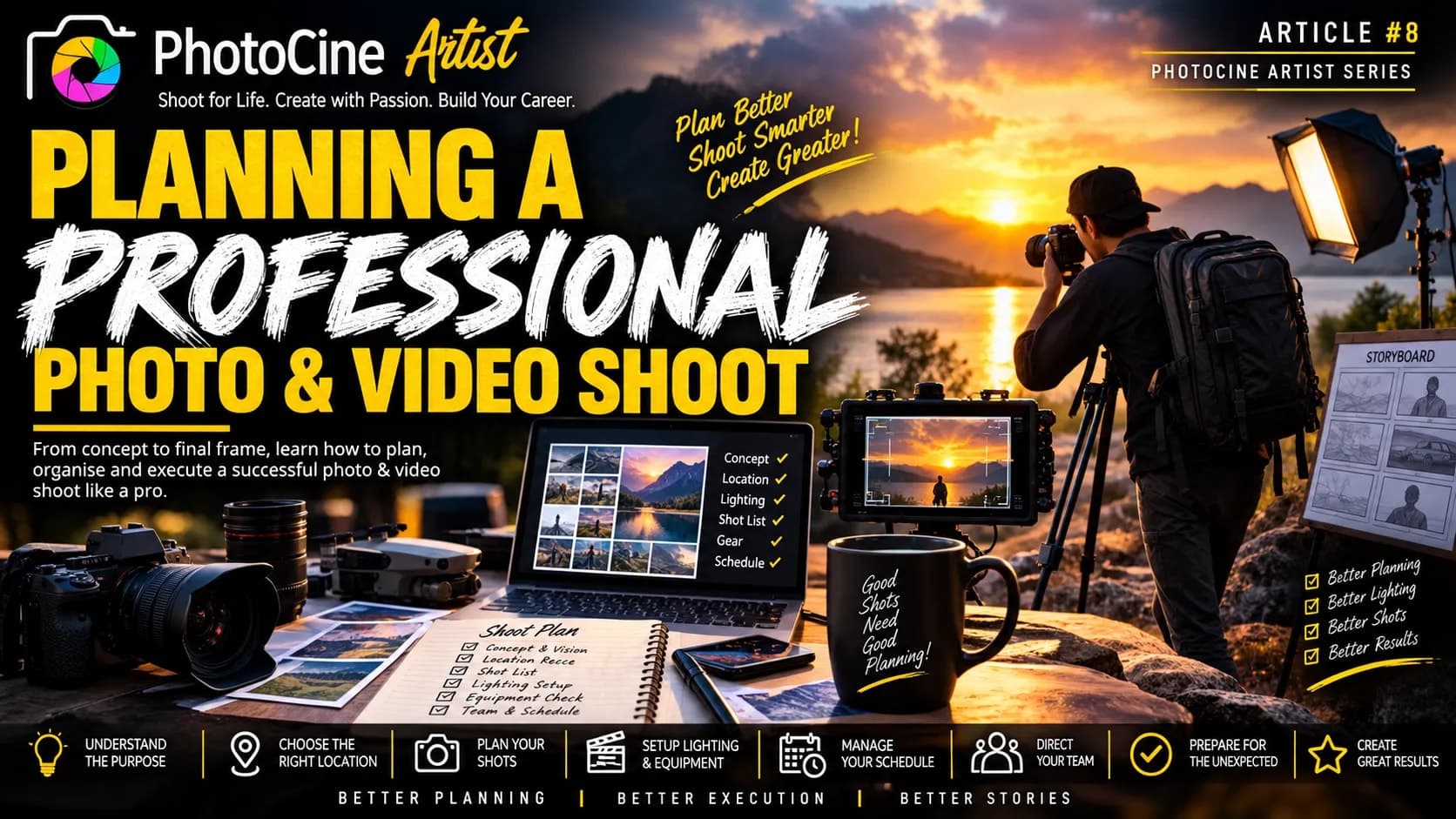
Every Great Shoot Begins Before the Camera
There is a moment in every creative project when an idea exists only in someone's imagination.
A brand wants to tell its story. A couple wants to preserve the emotion of their wedding. An entrepreneur wants to introduce a product to the world. A filmmaker wants to transform a script into something people can see and feel.
The vision may be powerful, but vision alone cannot organise a production.
Someone must turn the idea into a plan.
Photography and cinematography involve much more than operating a camera. They require preparation, communication, time management, technical decisions, creative direction, and the ability to solve problems when reality refuses to follow the original plan.
The more thoughtfully a shoot is prepared, the more freedom the creative team has to concentrate on what matters most: the images and the story.
Planning does not eliminate creativity.
It gives creativity room to work.
Begin With the Purpose, Not the Equipment
Before selecting a camera, lens, location, or lighting setup, understand why the shoot exists.
A photograph created for a luxury fashion campaign has different requirements from one created for a documentary. A corporate interview needs a different approach from a cinematic music video. A product image intended for an e-commerce listing has different priorities from a conceptual advertisement.
Start by identifying the purpose.
What is the central message? Who is the intended audience? Where will the final photographs or video appear? What should the viewer understand, remember, or feel?
These questions influence nearly every decision that follows.
For a product campaign, the objective may be to communicate quality and design. For a wedding film, it may be to preserve emotion and relationships. For a documentary, it may be to represent real people and events faithfully.
When the purpose is clear, creative choices become easier to evaluate.
A beautiful shot that contributes nothing to the objective may be unnecessary. A simple shot that communicates the message perfectly may become the most important image in the entire production.
Turn the Idea Into a Visual Direction
Ideas are often expressed in words, but photography and cinematography communicate through images.
A client might request something that feels premium, emotional, youthful, dramatic, natural, or cinematic. These descriptions provide a starting point, but they need visual interpretation.
Translate the desired feeling into decisions about colour, lighting, composition, movement, wardrobe, locations, and overall atmosphere.
A premium product campaign might use controlled reflections, restrained colours, precise framing, and deliberate camera movement.
A documentary might favour available light, natural environments, and an observational approach.
A music video might use expressive colour, stylised lighting, movement, and carefully choreographed transitions.
This is where references and mood boards become useful.
Collect visual examples that communicate the intended direction. They might include photographs, film frames, colour palettes, wardrobe references, locations, or lighting diagrams.
A mood board is not a collection of images to copy blindly. It is a shared visual language that helps everyone understand what the project is trying to become.
Build a Shot List
A creative idea can feel limitless until the shooting day begins.
Time is limited. Locations may be available for only a few hours. People may have other commitments. Weather can change, and equipment may need to be moved between setups.
A shot list converts the vision into a practical sequence of images.
For a product shoot, the list might include:
- A clean hero image showing the product clearly.
- Detail shots highlighting materials, controls, or craftsmanship.
- Lifestyle images showing the product in context.
- Alternate compositions for advertising and social media.
- Vertical and horizontal variations where required.
For a video production, the list might include establishing shots, wide shots, medium shots, close-ups, detail shots, transitions, and essential coverage of each action or scene.
A shot list does not have to predict every creative possibility.
Its purpose is to protect the essential requirements so the team can experiment without accidentally overlooking something important.
Create a Storyboard When the Project Needs One
A shot list describes what needs to be captured. A storyboard helps visualise how selected shots will appear and connect.
This is particularly useful for advertisements, scripted films, music videos, product demonstrations, and productions involving coordinated camera movement.
A storyboard can show the framing, subject placement, movement, and progression from one shot to the next.
It does not need to be an elaborate work of art. Simple sketches with short notes are often enough to communicate the idea.
For example, a short product advertisement might begin with a dark, mysterious close-up, reveal the product through a controlled lighting change, and finish with a clean hero frame.
Thinking through that sequence beforehand helps determine which equipment, lighting arrangements, and setups will be required.
The goal is not to remove improvisation.
It is to make intentional improvisation possible.
Choose the Right Location
A location is never merely a background.
It influences the available light, sound, movement, atmosphere, logistics, and the way a subject relates to the environment.
A visually beautiful location may be unsuitable if it is noisy, difficult to access, crowded, or too small for the planned equipment. A simple location may become exceptional when its light and surroundings support the concept.
Whenever possible, conduct a recce—a location visit before the shoot.
Observe the available space, natural light, power sources, access routes, parking, background distractions, and potential safety concerns.
For video, listen carefully to the environment. Traffic, machinery, crowds, air conditioning, and construction can make dialogue recording difficult.
For outdoor shoots, consider changing sunlight, wind, rain, permissions, and backup locations.
For commercial productions, confirm that the location can accommodate the team, equipment, client requirements, and planned activities.
The best location is not necessarily the most impressive one.
It is the location that serves the story and allows the production to work effectively.
Plan the Light Before You Arrive
Lighting can transform a location, but it also affects the time and resources a production needs.
Study how natural light moves through the location. Determine whether the shoot will rely on daylight, controlled artificial lighting, or a combination of both.
A portrait session may require only a window and a reflector. A commercial product shoot may require multiple lights, diffusion, flags, and careful control of reflections. A film scene may need consistent lighting across several camera angles.
Think about continuity as well.
If a scene is photographed from several angles, the lighting should remain believable and consistent unless a deliberate change is part of the story.
Prepare the equipment according to the intended result, not according to how much equipment you can bring.
More lights do not automatically produce better images. A well-planned setup often produces better results with less time and less confusion.
Select Equipment With Intention
Equipment should support the creative requirements of the shoot.
Choose the camera and lenses based on the intended framing, available light, movement, depth of field, and delivery requirements.
Check batteries, memory cards, chargers, cables, microphones, headphones, tripods, stabilisers, lighting equipment, and any accessories the production depends on.
For important assignments, carry reasonable backups for critical equipment where possible.
For video, remember that sound is part of the production. A visually beautiful interview with unintelligible dialogue can be unusable.
For photography, consider whether the project requires tethered shooting, colour-accurate monitoring, macro capability, or specific file formats.
Before the shoot, test the equipment and confirm that everything works together.
The purpose of preparation is not to carry everything.
It is to ensure that the essential tools are ready when the moment arrives.
Build a Realistic Schedule
A production schedule must account for more than the time spent taking photographs or recording footage.
Allow time for equipment setup, lighting adjustments, wardrobe and makeup, subject preparation, camera tests, transitions between scenes, breaks, and unexpected delays.
A sensible schedule identifies priorities.
If the weather changes or a setup takes longer than expected, the team should know which shots are essential and which can be simplified or postponed.
For outdoor photography, schedule important images around the expected quality and direction of light.
For video interviews, allow enough time to establish good sound and lighting before recording.
For larger productions, create a call sheet containing the essential information participants need, such as arrival times, location details, contact information, scene order, and relevant production notes.
A schedule should create clarity, not unrealistic pressure.
The objective is to give each important part of the shoot the time it deserves.
Direct People, Not Just Cameras
When a shoot involves models, actors, clients, interviewees, or a larger crew, communication becomes a creative tool.
People cannot be expected to understand an idea that has never been explained clearly.
A photographer working with a portrait subject should offer understandable direction rather than vague instructions. Instead of simply saying, "Look better," explain the desired expression, body position, or relationship with the light.
A director working with an actor should communicate the purpose and emotional intention of the scene.
An interviewer should help the subject feel comfortable enough to speak naturally.
Before shooting begins, establish expectations, explain the process, and create an environment in which people can ask questions.
For commercial work, confirm the agreed deliverables and obtain the appropriate permissions and releases.
Respect is not separate from professionalism.
It is one of its foundations.
Prepare for the Unexpected
No production plan can predict everything.
Clouds may cover the sun. A location may become unavailable. A battery may fail. A subject may arrive late. A client may request a change.
Professionalism is not the ability to prevent every problem.
It is the ability to respond without losing sight of the objective.
Build reasonable flexibility into the schedule. Keep essential backups. Identify alternative locations or lighting approaches where appropriate. Save work regularly, protect recorded media, and maintain clear communication when changes affect the plan.
For outdoor work, a weather contingency can be as important as the original schedule.
For data security, use a reliable backup workflow after capture. Where the assignment warrants it, maintain multiple copies on separate storage devices and verify that files are readable before considering the backup complete.
A prepared creative team does not assume everything will go perfectly.
It knows what to do when it does not.
Shoot With a Purpose, Then Explore
Preparation should establish the foundation, but the shooting day is where observation and instinct become equally important.
Follow the shot list. Protect the essential images. Monitor focus, exposure, sound, framing, and continuity.
Then remain open to what the environment offers.
A passing cloud may create beautiful soft light. A subject may make an unplanned gesture that reveals more character than the rehearsed pose. A reflection may introduce a composition nobody anticipated.
These moments are not necessarily distractions from the plan.
They may be opportunities that the plan could never have predicted.
The strongest creative process combines preparation with awareness. It knows what it came to achieve but remains alert to what it discovers along the way.
The Work Continues After the Shoot
The camera stopping does not mean the production is complete.
Photography often requires culling, selection, colour correction, retouching, and export. Video may require media organisation, editing, sound design, colour grading, graphics, and final delivery.
File management should begin during capture, not after everything becomes difficult to identify.
Use a consistent folder structure and descriptive file names. Keep original files safe. Organise footage by camera, scene, date, or another system appropriate to the project.
Confirm the required delivery formats, aspect ratios, resolutions, and deadlines before final export.
For commercial projects, clarify review rounds and approval responsibilities so that the final stage does not become an endless cycle of uncertainty.
A beautiful image is valuable, but a professional production must also deliver files that are organised, usable, and appropriate for their intended purpose.
Planning Creates Creative Freedom
There is a misconception that planning makes creativity rigid.
In reality, poor preparation is often what restricts creative freedom.
When the essential shots have been captured, the equipment is working, the schedule is under control, and the team understands the objective, the creative mind has more space to experiment.
The photographer can explore another angle.
The cinematographer can try a different movement.
The director can spend time refining a performance rather than solving a preventable logistical problem.
Preparation moves unnecessary uncertainty out of the way.
It allows attention to return to the subject, the emotion, and the image.
That is why planning is not the opposite of creativity.
It is the structure that allows creativity to survive the demands of a real production.
Every Great Frame Has a Story Behind It
When an audience sees a photograph, they rarely think about the location recce, the shot list, the equipment checks, or the schedule that made the image possible.
They see the final frame.
When an audience watches a film, they experience the story rather than the countless decisions behind each scene.
That invisibility is part of the craft.
The work behind the camera may be complex, but the final image should communicate clearly. Every preparation step should contribute to the result rather than exist for its own sake.
A PhotoCine Artist learns to respect both sides of the process: the imagination that creates the vision and the discipline that brings it into reality.
Because professional creativity is not simply the ability to make something beautiful when everything goes right.
It is the ability to prepare thoughtfully, work responsibly, adapt intelligently, and still create something meaningful when the unexpected happens.
Plan with discipline, create with freedom, and shoot with intention; because the strongest visual stories are not built by chance alone, but by artists who know how to turn an idea into reality.
Shoot for Life. Create with Passion. Build Your Career.
Welcome to PhotoCine Artist—where every great production begins with a vision, grows through preparation, and comes alive through the art of seeing.