
A camera can be held in the hands of almost anyone.
But creating a photograph that feels alive requires something more.
Before the first professional lens is purchased, before the perfect location is found, before expensive lights fill a studio, there is a simpler beginning:
Understanding how an image comes to life.
Photography is often introduced through buttons, menus and technical specifications.
ISO.
Shutter speed.
Aperture.
Focal length.
White balance.
Autofocus.
File formats.
All of these things matter.
But learning photography only through settings is like learning music by memorising the buttons on a piano.
The instrument is important.
The musician is more important.
And behind every memorable photograph is a person who understands not only how the camera works, but why the camera should work that way.
---
The Camera Is a Tool, Not the Artist
A camera does not know what is beautiful.
It does not understand love, loneliness, excitement, nostalgia or wonder.
It simply receives light and records information.
The photographer decides what that information should become.
Two people can stand in the same location with the same camera and photograph the same subject.
The photographs can still feel completely different.
One may feel warm.
Another dramatic.
Another lonely.
Another energetic.
Another timeless.
The difference is not necessarily the equipment.
It is the vision behind it.
This is the first lesson of becoming a PhotoCine Artist:
Master the camera, but never let the camera decide your vision.
---
Seeing Before Shooting
Before pressing the shutter, look.
Not quickly.
Actually look.
Observe where the light is coming from.
Notice what is happening in the background.
Watch how your subject is positioned.
Look at the colours.
Look at the shadows.
Look at the empty spaces.
Look at what does not belong inside the frame.
Photography begins before the photograph.
The camera simply records the final decision.
A beginner often asks:
"What settings should I use?"
An experienced photographer first asks themselves something deeper:
"What am I trying to show?"
Once that becomes clear, the technical decisions become easier.
---
Understanding Light
Photography literally means writing or drawing with light.
Without light, there is no photograph.
Light gives shape to a face.
It reveals texture.
It separates subjects from backgrounds.
It creates depth.
It creates mood.
It can make something feel soft or harsh, warm or cold, peaceful or dramatic.
The same person photographed under morning sunlight may look completely different under a small artificial light at night.
The subject did not change.
The light changed.
And therefore the story changed.
This is why learning photography is, in many ways, learning to see light.
---
The Three Foundations of Exposure
Every photograph is a conversation between light and the camera.
Three fundamental controls form the foundation of this relationship:
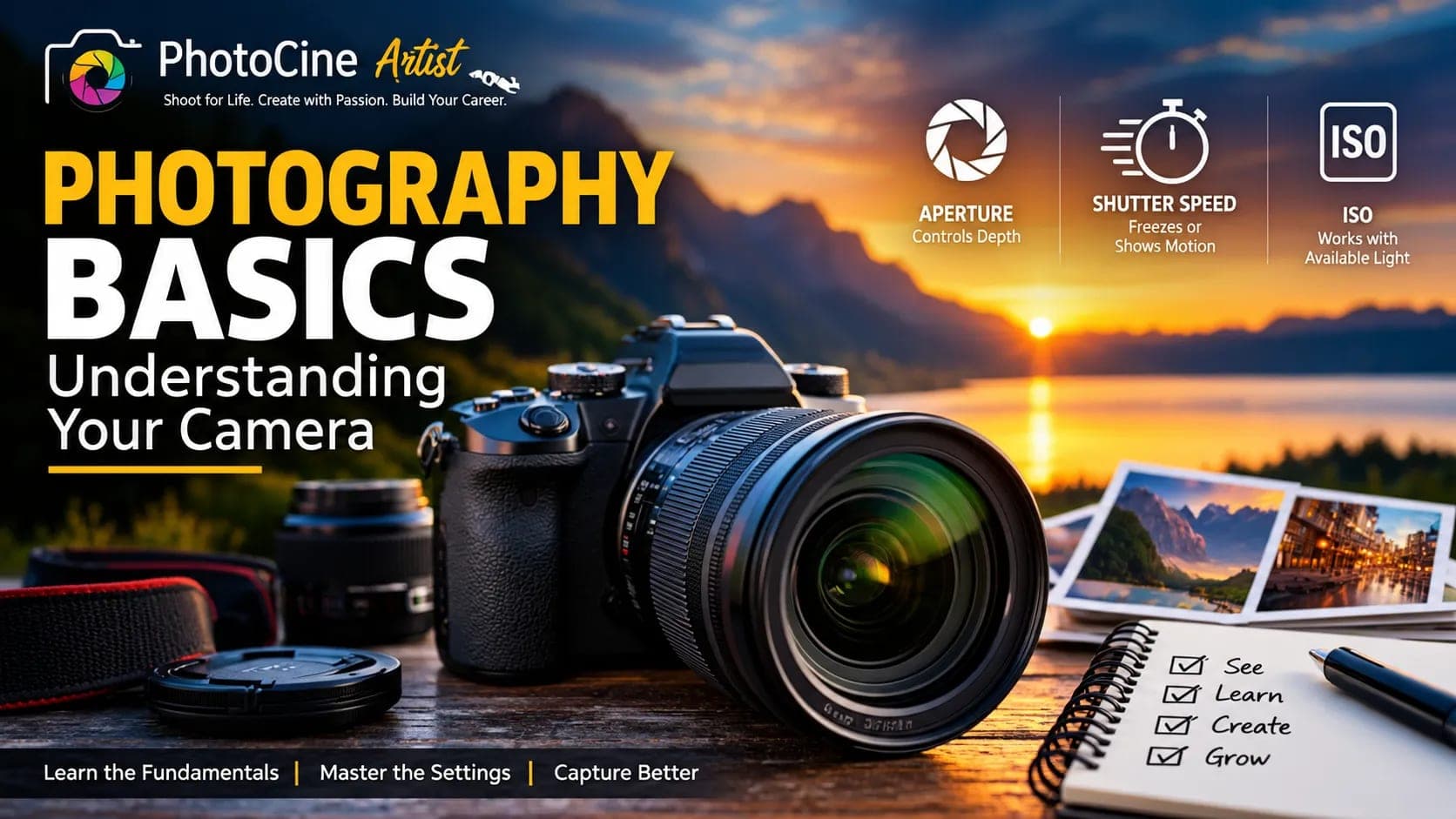
Aperture.
Shutter speed.
ISO.
Together, they determine how the camera records light and how the final photograph looks.
These are often introduced as technical settings.
But they are actually creative tools.
Aperture influences depth.
Shutter speed influences motion.
ISO influences sensitivity and image quality.
Once understood, these three controls stop being numbers inside a menu.
They become part of your visual language.
---
Aperture: Controlling Depth
Aperture is the opening through which light enters the lens.
But its creative importance goes far beyond brightness.
A wide aperture can separate a person from the background.
A narrow aperture can keep more of a scene in focus.
A portrait may benefit from a beautifully blurred background.
A landscape may demand greater depth.
A product photograph may require precision from front to back.
The photographer therefore chooses aperture according to the story.
A blurred background can say:
Look at this person.
A deeper focus can say:
Look at this entire world.
The setting becomes a storytelling decision.
---
Shutter Speed: Capturing or Freezing Time
Photography is the art of freezing time.
Shutter speed determines how long the camera allows light to reach the sensor.
A very fast shutter can freeze a moving athlete, a bird in flight or a drop of water.
A slower shutter can create motion blur.
It can show the movement of traffic.
The flow of water.
The movement of dancers.
The passing of people through a city.
Motion can either be stopped or allowed to become visible.
That is why shutter speed is not simply a technical number.
It is your decision about how time should appear inside the photograph.
---
ISO: Working With Available Light
Sometimes there is not enough light.
A photographer may be working indoors.
At night.
Inside a theatre.
During an event.
Under changing environmental conditions.
ISO allows the camera to become more responsive to available light.
But increasing ISO can also introduce noise and reduce image quality.
The goal is therefore not always to use the lowest ISO.
The goal is to find the right balance for the situation.
A technically noisy photograph of a genuine moment can sometimes be more valuable than a perfectly clean photograph of nothing important.
Technical perfection should serve the story—not replace it.
---
The Exposure Triangle
Aperture, shutter speed and ISO are connected.
Change one, and another may need to change.
Open the aperture.
Increase the shutter speed.
Raise the ISO.
Lower the ISO.
Every decision influences the others.
This relationship is commonly known as the exposure triangle.
Understanding it changes the photographer's relationship with the camera.
Instead of asking the camera to decide everything automatically, you begin taking control.
You stop merely operating the camera.
You start communicating through it.
---
Focus: Deciding What Matters
Every frame contains information.
But not everything deserves equal attention.
Focus helps establish priority.
A person's eyes.
A flower.
A product logo.
A moving subject.
A distant mountain.
The focus point tells the viewer where to look first.
Modern cameras offer sophisticated autofocus systems, face detection, eye detection and subject tracking.
These technologies are incredibly useful.
But technology should support intention.
The question is not simply:
"Is the camera focusing?"
It is:
"Is the camera focusing on what matters?"
---
Focal Length Changes Perspective
A lens does more than bring a subject closer or farther away.
Different focal lengths create different visual experiences.
Wide lenses can make spaces feel expansive.
Standard lenses can create a natural perspective.
Telephoto lenses can isolate distant subjects and compress visual relationships.
A portrait photographed with one focal length may feel intimate.
The same portrait photographed with another may feel environmental.
A landscape can feel enormous.
A city street can feel compressed.
A person can feel surrounded by their environment—or separated from it.
The lens therefore becomes another storytelling instrument.
---
Composition: Giving the Frame Order
Once exposure and focus are understood, another question appears:
Where should everything go?
That is composition.
A photograph is a rectangle.
Reality is not.
You have to decide what enters that rectangle and what stays outside it.
You decide where the subject stands.
Where the horizon falls.
Where the light appears.
Where the empty space remains.
Where the viewer's eye travels.
Rules such as the rule of thirds, leading lines, symmetry, framing and negative space can help.
But rules are not the destination.
They are vocabulary.
The experienced photographer eventually learns when to follow them, bend them or completely ignore them.
---
Backgrounds Matter More Than Beginners Think
A beautiful subject can be ruined by a distracting background.
A pole appearing behind someone's head.
A bright object competing with the subject.
Messy surroundings.
Unwanted colours.
Random objects.
The photographer sees the subject.
The viewer sees the entire frame.
This difference is important.
Before pressing the shutter, scan the edges.
Look behind your subject.
Look above.
Look below.
Sometimes the simplest improvement is not changing the camera.
It is taking three steps to the left.
---
Colour Is Emotion
Colour affects how an image feels.
Warm colours can suggest comfort, energy or nostalgia.
Cool colours can suggest distance, calmness or loneliness.
Strong colours can create excitement.
Muted colours can create subtlety.
Black and white can remove distractions and focus attention on light, texture and expression.
Colour grading later can enhance an image.
But the visual story often begins at the moment of capture.
Understanding colour means understanding that photographs do not simply show objects.
They create feelings around those objects.
---
The Difference Between Taking and Making a Photograph
Anyone can take a photograph.
The camera makes that possible.
But making a photograph is different.
Taking a photograph can be accidental.
Making one involves intention.
You observe.
You decide.
You position.
You wait.
You adjust.
You capture.
You review.
You learn.
That process transforms photography from recording into creation.
A PhotoCine Artist is not simply collecting images.
They are making visual decisions.
---
Learn Your Camera Until It Disappears
A beginner often thinks about the camera while shooting.
Where is the button?
Which mode?
Which menu?
Which setting?
Which autofocus option?
Eventually, technical knowledge should become instinctive.
You should be able to change important settings without losing the moment.
You should know your camera's strengths.
You should understand its limitations.
You should know how it behaves in darkness.
You should know how quickly it focuses.
You should know how it handles highlights.
You should know how it handles shadows.
The ultimate goal is not to think about the camera constantly.
It is to make the camera disappear from your attention.
Then you can concentrate on the story.
---
Your First Camera Does Not Need to Be Your Best Camera
There is a temptation to believe that better equipment automatically creates better work.
It does not.
A professional camera gives you more possibilities.
It does not automatically give you better ideas.
Your first camera should be something you can learn deeply.
Shoot with it.
Make mistakes with it.
Experiment with it.
Take hundreds of photographs.
Then thousands.
You will eventually discover what you need from your equipment.
Only then does upgrading become meaningful.
The best camera is not necessarily the most expensive one.
It is the one you understand well enough to use creatively.
---
Practice Is Where Knowledge Becomes Skill
Reading about photography can teach you concepts.
Watching tutorials can teach you techniques.
But neither can replace practice.
Photograph the same object at different times of day.
Photograph the same person with different light.
Photograph a street using different focal lengths.
Freeze motion.
Create motion blur.
Try shallow depth of field.
Try deep focus.
Shoot in difficult light.
Shoot without changing your position.
Then change your position.
Make mistakes deliberately.
Study the results.
The camera becomes understandable through repetition.
Knowledge tells you what is possible. Practice teaches you how it feels.
---
Start With What You Have
You do not need a studio to begin.
You do not need an expensive cinema camera.
You do not need a collection of lenses.
You do not need a perfect location.
You need something worth observing.
A window.
A cup of coffee.
A friend.
A street.
A building.
A tree.
A sunset.
A moving vehicle.
Your own reflection.
Your phone.
Your first assignment can be your own life.
Because the purpose of learning photography is not to wait until you have the perfect subject.
It is to develop the ability to find photographs wherever you are.
---
From Camera Operator to PhotoCine Artist
There is a point in every creative journey where the technical questions begin to become quieter.
You stop thinking only about settings.
You start thinking about meaning.
You stop asking how to make an image look professional.
You begin asking how to make it feel personal.
You begin noticing light without consciously searching for it.
You begin seeing compositions while walking.
You begin recognising stories inside ordinary moments.
This is when the camera starts becoming an extension of your vision.
And this is where the journey from photographer to PhotoCine Artist truly begins.
---
The First Lesson Is Not the Camera
Photography has many technical lessons waiting ahead.
Exposure.
Composition.
Lighting.
Lenses.
Colour.
Editing.
Portraiture.
Commercial work.
Cinematography.
Storytelling.
Professional production.
Career.
But every lesson eventually returns to the same foundation:
See first.
Then think.
Then create.
The camera is only the bridge between what exists in front of you and what exists inside your vision.
Learn the buttons.
Understand the settings.
Study the lenses.
Master the exposure.
But never forget why you picked up the camera in the first place.
Because somewhere in front of you, there was a moment worth seeing.
And you decided not to let it disappear.
Shoot for Life.
Create with Passion.
Build Your Career.
The camera records what is in front of you. The PhotoCine Artist decides what is worth remembering.
“Mastering the camera is not about controlling every button; it is about reaching the moment when technology becomes invisible and your vision becomes the photograph.”