
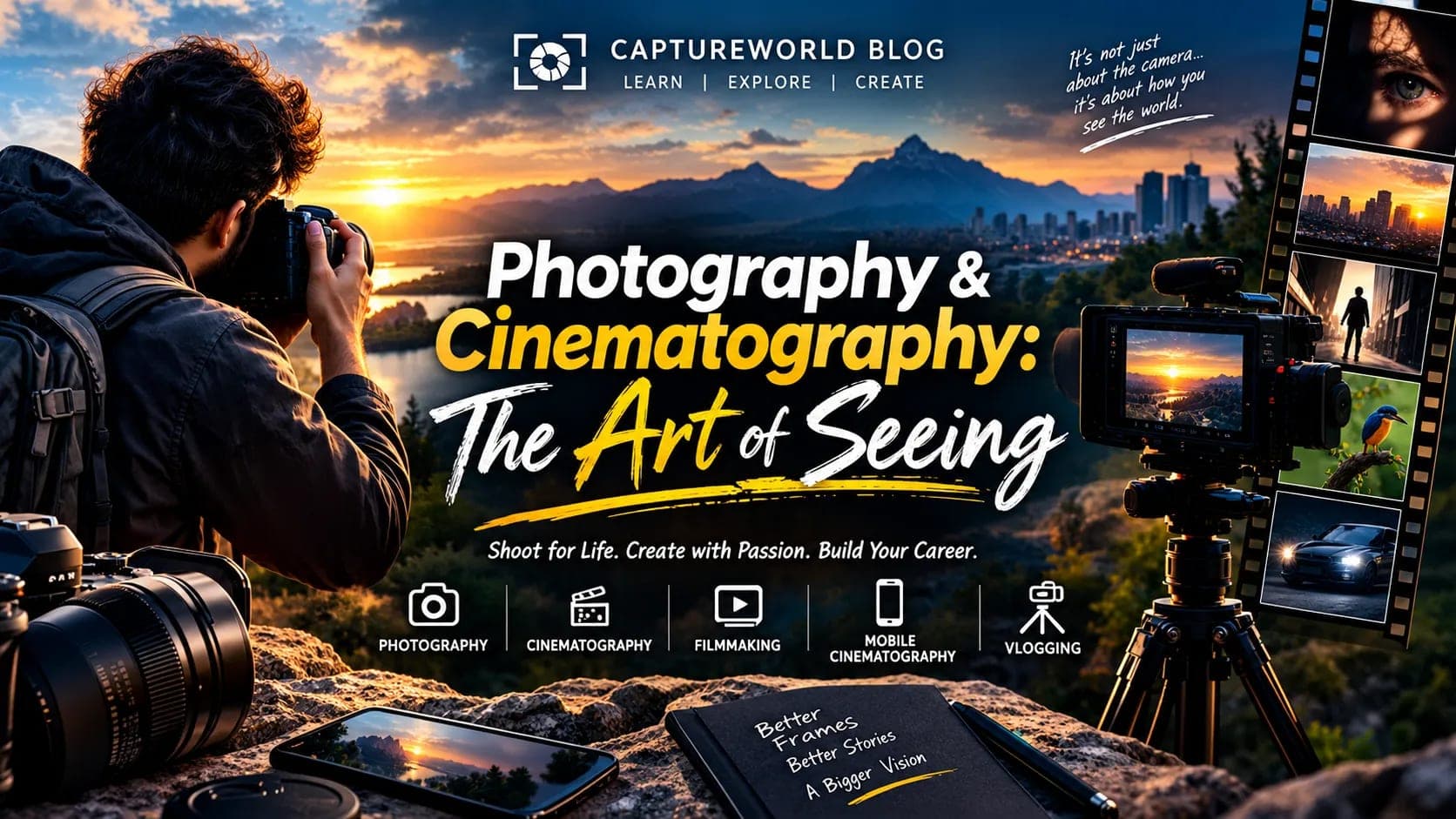
A child takes his first step.
A father quietly watches his family grow.
A bride walks toward a new chapter of her life.
A craftsman spends years perfecting a skill.
A machine begins its first production cycle.
A traveller stands before a mountain for the first time.
A musician performs a song that once existed only in his imagination.
Life keeps moving.
We see these moments, experience them, and move forward.
But photography and cinematography give us the ability to pause.
They allow us to take something that exists for only a fraction of a second—or a few minutes—and give it another life.
That is where the journey of a PhotoCine Artist begins.
Not with a camera.
Not with a lens.
Not with expensive equipment.
It begins with the ability to see.
Before There Was a Camera, There Was a Desire to Remember
Long before cameras existed, human beings were already trying to preserve what they saw.
- They painted animals on cave walls.
- They drew people, places and events.
- They carved stories into stone.
- They created paintings to preserve faces, cultures, battles, celebrations and beliefs.
The technology changed over centuries, but the human desire remained the same:
“I saw this. I experienced this. I want this to remain.”
Photography was another chapter in that journey.
A camera didn't create our desire to remember.
It gave that desire a new language.
With a photograph, a fraction of life could suddenly be preserved with extraordinary detail.
And eventually, cinematography took that idea further.
- A photograph could preserve a moment.
- A moving image could preserve the experience of time itself.
- A person could walk.
- A door could open.
- A tear could fall.
- A crowd could celebrate.
- A city could wake up.
- A story could unfold.
The frame began to move.
And visual storytelling entered another dimension.
The Camera Is a Tool. Seeing Is the Skill.
It is easy to believe that better equipment creates better photographs.
- A bigger camera.
- A sharper lens.
- A larger sensor.
- More megapixels.
- More dynamic range.
- More expensive lights.
- More advanced cinema equipment.
Technology certainly matters.
It can give an artist greater control and greater possibilities.
But equipment alone cannot decide what deserves to be captured.
- A camera can record a face.
- It cannot understand the relationship behind that face.
- A camera can record a sunset.
- It cannot feel what that sunset means to the person standing beneath it.
- A camera can record a wedding.
- It cannot understand the years of relationships that brought two people to that moment.
That understanding comes from the person behind the camera.
The camera captures what is in front of it. The artist decides what is worth showing.
This distinction is at the heart of photography and cinematography.
Photography Is the Art of Preserving a Moment
Photography lives in a strange relationship with time.
A moment happens once.
Then it is gone.
But a photograph can make that moment available again.
Years later, an old photograph can suddenly bring back a place, a person, a smell, a feeling or an entire chapter of life.
That is why photography is more than the creation of beautiful images.
It is also memory, communication, documentation, observation and expression.
- A photograph can be personal.
- It can be commercial.
- It can be scientific.
- It can be artistic.
- It can be historical.
- It can be informative.
- It can be emotional.
- It can even be invisible in its importance.
A photograph documenting the condition of a machine may never hang on a wall, yet it may help a manufacturer understand a failure.
A photograph of a product may exist for only a few seconds on an online store, yet influence someone's decision to purchase it.
A photograph of a building may help communicate an architect's work.
A photograph of a person may become part of a company's identity.
A photograph taken casually on a smartphone may become one of the most valuable memories a family possesses.
The photograph doesn't have to be famous to be important.
Sometimes its greatest value exists in only one person's heart.
Cinematography Gives Time a Language
If photography is the art of preserving a moment, cinematography is the art of shaping moments into movement.
- One frame becomes another.
- One action follows another.
- One emotion develops into another.
The audience doesn't simply see an image.
They experience a sequence.
This is why cinematography is not simply photography with movement.
It introduces time, rhythm, motion, continuity, perspective and progression.
- A camera can remain still while the world moves.
- A camera can move while the subject remains still.
- A wide shot can establish a world.
- A close-up can reveal a thought.
- A change in light can change the emotion of a scene.
- A change in lens can change the relationship between the audience and the subject.
- A few seconds of silence can sometimes communicate more than a paragraph of dialogue.
Cinematography therefore becomes a language of its own.
The camera doesn't merely record the story. It participates in telling it.
Light Is Where the Story Begins
Photography and cinematography have another fundamental connection.
Light.
- Before composition.
- Before lenses.
- Before colour grading.
- Before cameras became digital.
There was light.
- Light reveals shape.
- Light creates shadow.
- Light separates subjects.
- Light reveals texture.
- Light creates depth.
Light can make a familiar place feel unfamiliar.
The same person can appear completely different under different lighting conditions.
- Morning sunlight can feel gentle.
- Midday sunlight can feel harsh.
- A window can create intimacy.
- A streetlight can create isolation.
- A softbox can create control.
- A practical lamp can make a scene feel lived-in.
- A dramatic backlight can turn an ordinary person into a silhouette.
Learning photography therefore means learning to see light before learning to control it.
And learning cinematography means understanding how that light behaves not only within a frame, but throughout an entire sequence.
The Frame Is a Choice
The world has no natural frame.
We create one.
When you raise a camera, you are making a decision.
You are saying:
This belongs in the story.
This does not.
- You choose the distance.
- You choose the angle.
- You choose the perspective.
- You choose the amount of empty space.
- You choose what appears in the background.
- You choose what remains outside the frame.
That is why composition is not simply about following rules.
Rules such as the Rule of Thirds, leading lines, symmetry, balance and negative space are useful ways of understanding visual relationships.
But eventually, composition becomes something deeper.
It becomes intent.
A great photograph isn't great because it followed a mathematical rule.
It is great because every element within the frame contributes to what the artist wants the viewer to experience.
The World Doesn't Need to Be Beautiful to Be Worth Capturing
One of the most important lessons in visual creation is learning to find meaning in ordinary things.
A photographer doesn't always need mountains.
A cinematographer doesn't always need a spectacular location.
A beautiful sunset can create a beautiful image.
But beauty is not the only reason to create.
- A workshop filled with dust can tell a story.
- An old pair of hands can tell a story.
- A quiet street can tell a story.
- A factory floor can tell a story.
- A small tea stall can tell a story.
- A person waiting at a railway station can tell a story.
- A broken machine can tell a story.
- A child's expression can tell a story.
The ordinary world is full of extraordinary details.
The difference is not always what exists in front of the camera. Sometimes it is what the person behind the camera notices.
Photography Belongs to Every Industry
There is a tendency to think of photography as a profession that belongs only to photographers.
But look closely at the world around us.
Almost every industry depends on visual communication.
- Manufacturing requires documentation.
- Engineering requires visual records.
- Architecture requires visual presentation.
- Real estate requires property imagery.
- Automotive companies require product photography and films.
- Fashion requires visual identity.
- Hospitality depends heavily on visual experience.
- E-commerce depends on product images.
- Advertising depends on visual persuasion.
- Education increasingly depends on visual explanation.
- Travel depends on visual inspiration.
Businesses use photography to present their people, products, facilities and culture.
Individuals use photography to preserve their lives.
And social media has turned almost everyone with a smartphone into a potential visual creator.
The role of photography has therefore expanded far beyond the traditional studio.
Wherever something needs to be seen, understood, remembered, documented or communicated, visual storytelling has a place.
And Then Came the Smartphone
For decades, professional visual creation was strongly associated with specialised equipment.
Today, a device that fits inside a pocket can photograph, record, stabilise, edit and publish a story within minutes.
The smartphone didn't eliminate the need for professional cameras.
It changed who could participate.
- A student can create.
- A business owner can create.
- A traveller can create.
- A journalist can create.
- A musician can create.
- A filmmaker can experiment.
- A person documenting ordinary life can become a storyteller.
Mobile photography and mobile cinematography have made the distance between having an idea and creating something visual smaller than ever.
The important question is no longer only what equipment someone owns.
It is what they understand.
A great tool in inexperienced hands remains a tool. An ordinary tool in creative hands can become an instrument of expression.
From Photograph to Story
The deeper we go into photography and cinematography, the more we realise that technical knowledge is only one part of the craft.
Knowing aperture doesn't automatically make someone a photographer.
Knowing shutter speed doesn't automatically make someone a cinematographer.
Knowing how to operate a cinema camera doesn't automatically make someone a filmmaker.
The technical side gives us control.
But storytelling gives that control purpose.
The artist begins to think about:
- What should the audience notice?
- What should they feel?
- What should they remember?
- What should remain unsaid?
This is where photography begins to meet storytelling.
A single photograph can suggest an entire story.
A sequence of photographs can document a journey.
A series of moving images can create a world.
And eventually, the creator learns that the most powerful visual isn't always the most technically perfect one.
Sometimes it is simply the one that makes someone feel something.
The PhotoCine Artist
The term PhotoCine Artist represents the space between photography, cinematography and visual storytelling.
It is not about choosing whether one is a photographer or cinematographer.
It is about understanding the common foundation behind both.
- See.
- Understand.
- Imagine.
- Compose.
- Capture.
- Create.
- Tell.
A PhotoCine Artist may use a professional mirrorless camera one day and a smartphone the next.
They may photograph a wedding in the morning and create a corporate film in the afternoon.
They may document their own life through a vlog or spend weeks creating a documentary.
They may create an advertisement, photograph a product, shoot a music video or simply capture a moment with someone they love.
The subject changes.
The equipment changes.
The purpose changes.
But the fundamental skill remains:
the ability to turn observation into visual communication.
From Life to Passion, From Passion to Profession
For some people, photography will always remain personal.
It will be the way they remember their family, travels, friendships and everyday experiences.
For others, it will become a passion.
They will spend weekends experimenting with lenses, light, composition, colour and storytelling.
And for some, that passion will gradually become a profession.
- A portfolio will replace casual photographs.
- Clients will replace personal projects.
- Production schedules will replace spontaneous shoots.
- Budgets will become part of the creative process.
A hobby will become a service.
A skill will become a business.
A camera will become a professional tool.
But the foundation should remain the same.
Create because you have something worth showing.
The Journey Begins Before the Camera Settings
There will be time to talk about aperture.
There will be time to understand shutter speed.
There will be time to explore ISO, lenses, autofocus, composition, lighting, colour, editing and every other technical element that forms the craft.
There will be time to understand how to plan a corporate production, photograph a wedding, create a documentary, produce an advertisement, shoot a music video, build a vlog or tell a story through a smartphone.
But before all of that, there is one lesson worth carrying with you:
Don't rush to learn how to operate the camera before learning how to observe the world.
Because once you learn to see, the camera becomes easier to understand.
- You begin to recognise light.
- You notice composition.
- You anticipate moments.
- You understand emotion.
- You begin to see possibilities where others see ordinary scenes.
And slowly, photography stops being about taking pictures.
Cinematography stops being about recording videos.
- They become ways of thinking.
- Ways of observing.
- Ways of communicating.
- Ways of remembering.
- Ways of creating.
Welcome to the Journey
PhotoCine Artist is not intended to be a collection of camera tutorials alone.
It is a journey through the entire visual craft—from understanding the art and its place in everyday life and industry, to learning cameras and composition, understanding light, planning productions, developing visual stories, working professionally and eventually building a career around the craft.
The journey will move from seeing to understanding, from understanding to creating, and from creating to mastering.
Because the ultimate goal isn't simply to own a better camera.
It is to become a better observer.
A better storyteller.
A better creator.
And perhaps, eventually, a better artist.
Shoot for Life. Create with Passion. Build Your Career.
Welcome to PhotoCine Artist—where we don't simply learn how to capture the world; we learn how to see it.