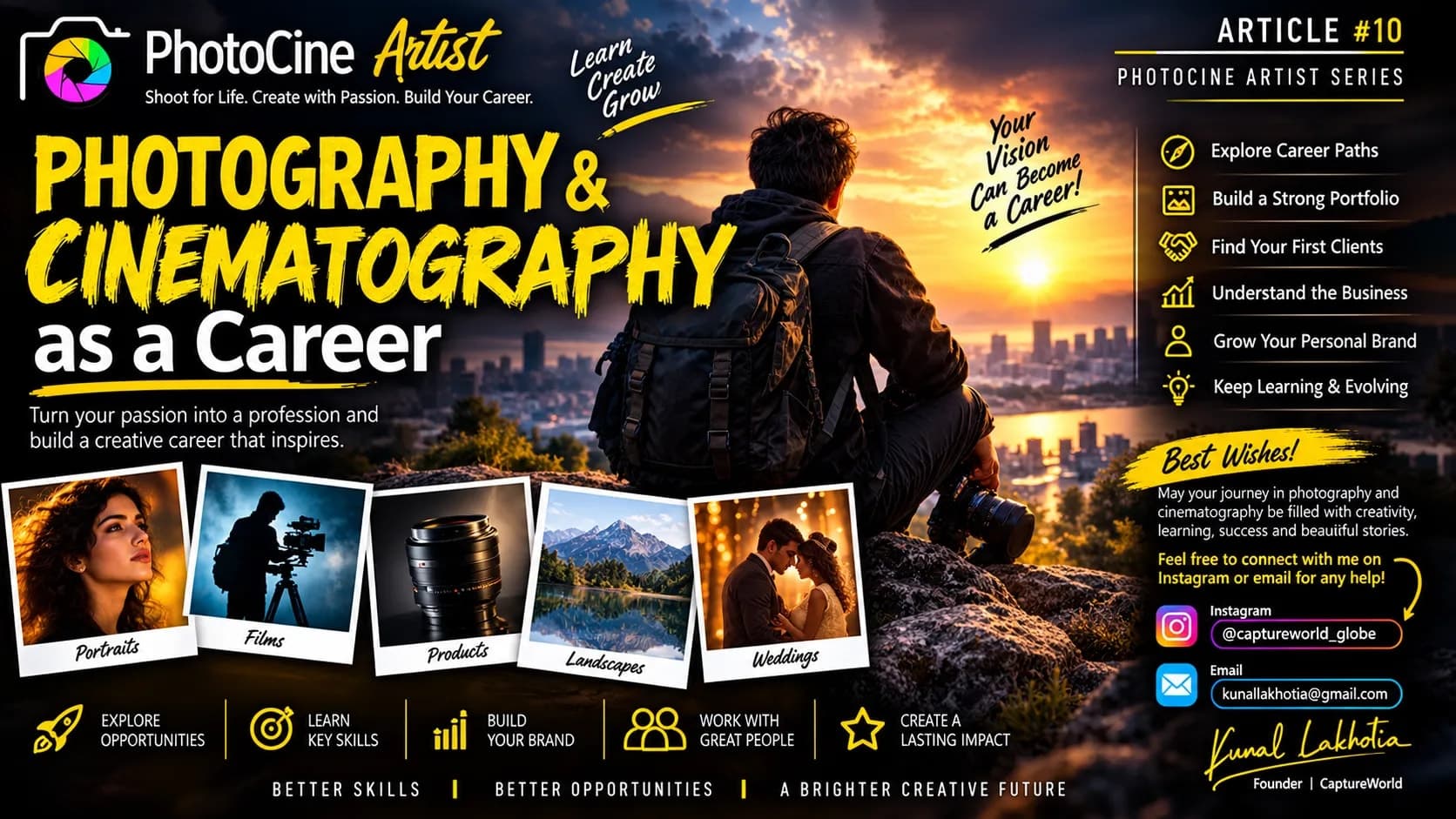
From Passion to Profession
There is something extraordinary about the ability to preserve a moment that would otherwise disappear.
A photograph can bring back the feeling of a forgotten afternoon. A wedding film can allow a family to relive one of the most meaningful days of their lives. A commercial film can introduce a brand to millions of people. A documentary can bring attention to stories that might otherwise remain unseen.
Behind every one of these creations is someone who learned to turn observation into expression.
Perhaps you began with a mobile phone, taking pictures of sunsets, friends, buildings, or ordinary moments that caught your attention. Perhaps you watched films and wondered how a particular scene was lit, how the camera moved, or why an image made you feel something you could not quite explain.
That curiosity matters.
It may be the beginning of a lifelong creative pursuit.
But turning that curiosity into a profession requires more than passion. It requires learning, practice, patience, discipline, communication, and the willingness to keep improving even when progress feels slow.
A career in photography and cinematography is not built in a single moment.
It is built one frame, one project, one lesson, and one decision at a time.
Discover Your Own Direction
Photography and cinematography are not single professions with only one path to success.
They are broad creative worlds containing many different specialisations, working styles, and opportunities.
You might discover that you love portrait photography because you enjoy understanding people and capturing their personalities.
You might be drawn to fashion because you appreciate styling, design, and visual experimentation.
You might find your place in commercial photography, creating images for products, businesses, and advertising campaigns.
You might prefer weddings, where observation, anticipation, and emotional sensitivity are essential.
Or perhaps cinematography is what excites you most: shaping light, choosing lenses, designing camera movement, and translating ideas into moving images.
Other paths include documentaries, wildlife, travel films, architecture, food photography, music videos, corporate productions, real estate, sports, photojournalism, and content creation.
You do not need to master every field.
Explore different possibilities, learn the foundations, and pay attention to the work that makes you want to keep creating even when nobody is watching.
Your direction may change as you gain experience. That is part of the journey.
The goal is not to choose your entire future on the first day.
It is to discover what deserves your attention next.
Skills That Make You a Professional
A camera can record an image, but a professional must understand how to create the right image for a particular purpose.
That requires several connected skills.
Technical knowledge helps you control exposure, focus, lenses, camera settings, lighting, and image quality.
Creative understanding helps you use composition, colour, perspective, timing, and visual storytelling to communicate meaning.
Practical preparation helps you plan shoots, organise equipment, manage time, and anticipate problems.
People skills help you communicate with clients, direct subjects, collaborate with a crew, and understand what a project needs.
Post-production skills help you select, edit, colour-correct, retouch, and deliver your work professionally.
Business skills help you price projects, manage expenses, negotiate agreements, market your services, and build sustainable relationships.
These abilities support one another.
A technically skilled photographer may struggle if they cannot understand a client's brief. A creative filmmaker may find it difficult to sustain a business without reliable planning and delivery.
The strongest professionals continue developing both their craft and their ability to work with people.
Build a Portfolio, Not Just a Collection
Your portfolio is more than a folder of photographs or a collection of video links.
It is evidence of what you can do.
When someone considers hiring you, they want to understand your visual style, your consistency, your technical ability, and whether your work suits their needs.
Start by selecting your strongest work rather than displaying everything you have ever created.
If you want to work in product photography, show that you understand lighting, materials, reflections, composition, and commercial presentation.
If you want to become a wedding photographer, demonstrate your ability to capture people, emotions, details, and important moments.
If you want to work in cinematography, include carefully selected scenes that demonstrate framing, movement, lighting, and continuity.
When you are beginning, you can create personal projects, collaborate with other creatives, or develop clearly identified concept shoots to demonstrate your abilities.
Be honest about your role in each project.
A focused portfolio that communicates your strengths is often more useful than a large portfolio without a clear direction.
And remember that a portfolio is never truly finished. As your skills improve, your work should evolve with them.
Your First Camera Does Not Define Your Future
One of the most common obstacles for beginners is the belief that better equipment must come before meaningful progress.
A new camera can offer advantages. Different lenses, better autofocus, improved low-light performance, and professional recording capabilities can all be valuable.
But equipment cannot replace the ability to recognise a good composition, understand light, anticipate a moment, or communicate an idea.
Learn to use the tools available to you.
A mobile phone can teach you framing, perspective, timing, storytelling, and the discipline of observing light. An entry-level camera can teach you exposure, focal length, focus, and depth of field.
As your projects grow more demanding, you can invest in equipment that solves specific limitations.
Before purchasing something new, ask yourself what problem it will solve and whether that problem genuinely prevents you from doing the work you want to do.
Build your skills first, understand your requirements, and upgrade with intention.
The value of an artist is not measured by the price of their camera.
It is revealed by what they can create with it.
Experience Is More Valuable Than Endless Preparation
Learning is essential, but there comes a point when watching another tutorial cannot teach you what actually happens during a real shoot.
You need experience.
Offer to photograph a personal project. Create a short film. Work with a local business. Collaborate with a makeup artist, model, musician, designer, or fellow filmmaker.
Begin with projects that are realistic for your current abilities.
Prepare properly. Communicate clearly. Deliver what you promise. Review your work honestly after every assignment.
You will make mistakes.
You may misjudge the light, miss a moment, underestimate the time required, or discover during editing that an important shot is missing.
These experiences can be frustrating, but they are also among the most effective teachers you will encounter.
The important thing is to learn from them rather than repeat them without reflection.
Confidence grows when you see yourself solving problems that once seemed difficult.
You do not need to wait until you feel completely ready.
You need to start responsibly, work within your capabilities, and keep developing.
Finding Your First Clients
For many aspiring photographers and cinematographers, the transition from creating work to finding paid work is one of the most challenging stages.
Begin with relationships and visibility.
Share your strongest work consistently. Build a clear portfolio. Explain the services you offer. Make it easy for potential clients to contact you.
Connect with local businesses, event organisers, agencies, artists, production houses, designers, and other professionals whose work may benefit from visual content.
When approaching a potential client, avoid sending only a generic message asking for work. Demonstrate that you understand their business or project, explain how your skills might help, and share relevant examples.
Your first assignment may be small. Treat it seriously.
Understand the brief, confirm the deliverables, agree on the budget and timeline, and communicate throughout the project.
A satisfied client may return, recommend you to someone else, or introduce you to an opportunity you would not have discovered independently.
Professional relationships are built through trust, not simply through visibility.
Understand the Business Behind the Art
A creative career can be deeply rewarding, but passion does not remove the need for financial planning.
You must understand the difference between revenue and profit, account for expenses, and price projects in a way that reflects the work involved.
A quote may need to include pre-production, shooting time, assistants, equipment, transport, rentals, editing, licensing, revisions, and delivery.
Not every project will require all these elements, but each relevant cost should be considered.
Clearly define what the client will receive, when it will be delivered, how many revisions are included, and how the images or footage may be used.
For larger projects, use appropriate written agreements and clarify payment terms before production begins.
Avoid pricing solely by the number of hours spent holding a camera. The value of professional work also comes from preparation, experience, creative decisions, reliability, and the final result.
At the same time, understand your current position in the market. Your pricing should be realistic for your experience, the scope of the assignment, and the value you deliver.
A sustainable creative business allows you to continue creating without turning every opportunity into financial pressure.
Build Your Personal Brand
Your work introduces your abilities, but your professional identity helps people understand who you are and what you stand for.
A personal brand does not require you to become an internet celebrity.
It requires clarity and consistency.
Show the kind of work you want to be hired for. Explain your creative approach. Share selected behind-the-scenes moments. Demonstrate how you solve problems and think about visual storytelling.
Your website, portfolio, social profiles, and communication should work together to present a recognisable professional identity.
Instagram can help you share photographs, reels, and project updates. A website can provide a more organised portfolio and a place for enquiries. Professional networks can help you connect with businesses, agencies, and production teams.
Choose platforms that suit your audience and goals instead of feeling compelled to be everywhere.
Do not measure your worth entirely through likes, views, or follower counts.
Social media can increase visibility, but a successful creative career also depends on the quality of your work, your relationships, your reputation, and your ability to deliver.
Build a presence that reflects the artist you are becoming.
The Power of Collaboration
Photography and cinematography often appear to be individual pursuits because one person may be seen behind the camera.
In reality, many productions depend on a network of creative professionals.
A photographer may collaborate with a stylist, makeup artist, art director, model, and retoucher. A cinematographer may work with a director, camera assistant, gaffer, production designer, sound recordist, and editor.
Each person brings a different perspective and a different set of skills.
Learning to collaborate teaches you how to communicate ideas, respect other people's expertise, and contribute to a shared vision.
It also exposes you to approaches you might never discover working alone.
You do not need to build a large team immediately. Start by forming genuine relationships with people whose interests complement your own.
Share credit appropriately. Respect agreed terms. Be dependable. Treat assistants, clients, subjects, and collaborators with professionalism.
Talent may create an opportunity.
Character often determines whether people want to work with you again.
Keep Learning in a Changing Industry
The tools of visual creation continue to evolve.
Camera systems become more capable. Editing workflows change. Mobile devices improve. Artificial intelligence introduces new methods for planning, generating, editing, and organising visual content.
These changes can feel overwhelming if you believe that every new technology must be mastered immediately.
Instead, focus on understanding the foundations that remain valuable across different tools.
Learn how light behaves. Understand composition. Study visual storytelling. Develop your ability to direct attention and evoke emotion.
Then explore technologies that help you work more effectively.
AI can assist with ideation, planning, organisation, and selected post-production tasks, depending on the workflow. New camera systems can simplify technical challenges. Editing tools can make previously difficult processes more accessible.
But tools still require judgement.
You must decide whether an image serves the brief, whether a visual choice is appropriate, whether an edit preserves the intended meaning, and whether the final work meets professional and ethical expectations.
Do not become so attached to one tool that you stop learning.
And do not become so fascinated by new technology that you forget why you started creating in the first place.
Learn to Handle Rejection and Slow Progress
Not every proposal will become a project.
Not every photograph will work.
Not every film will receive the response you hoped for.
There will be periods when progress feels slower than expected. You may compare your beginning with someone else's tenth year and wonder whether you are moving fast enough.
Comparison can sometimes reveal something worth learning, but it can also make you overlook your own development.
Study other artists without treating their achievements as proof of your limitations.
When a client declines your proposal, try to understand whether the issue was budget, timing, creative direction, experience, or simply a mismatch.
When a project disappoints you, review what you could improve.
When you feel stuck, return to practice.
You do not need to turn every rejection into a dramatic motivational story. Sometimes it is simply a normal part of working in a competitive field.
The important thing is to remain curious, respond constructively, and continue making progress.
Consistency is not about feeling inspired every day.
It is about returning to the work even when inspiration is quiet.
Success Does Not Have Only One Definition
For some artists, success means working on films, advertisements, or campaigns seen by millions.
For others, it means running a respected photography business, creating meaningful documentaries, documenting weddings, or earning a stable living through a craft they love.
Some will build production houses and lead teams. Others will prefer independent work, small projects, and the freedom to choose their own subjects.
There is no single career structure that suits everyone.
Define what you want your creative life to provide.
Do you want to travel? Work with brands? Tell human stories? Build a company? Specialise in one field? Maintain a flexible independent practice?
Your answers may change as you grow.
Let them.
A meaningful career is not necessarily the one that looks most impressive from the outside. It is one that allows you to develop your abilities, support your responsibilities, work with integrity, and create things you believe are worth making.
Build towards a definition of success that belongs to you.
Your Journey Begins With the Next Frame
By now, you have explored the foundations of photography and cinematography: understanding the camera, controlling exposure, composing an image, shaping light, planning a shoot, and communicating through visual storytelling.
These are not separate islands of knowledge.
They connect.
Camera settings help you control the image. Composition gives its elements structure. Light creates atmosphere. Planning helps you execute the idea. Storytelling gives the final frame meaning.
Together, these skills create a foundation on which you can build your own visual language.
But reading about photography and cinematography is only the beginning.
The real learning happens when you put these ideas into practice, observe the results, recognise what went wrong, and try again.
Photograph the ordinary things around you. Make short films. Experiment with light. Study images that inspire you. Collaborate with other creatives. Build a portfolio that reflects your progress.
You do not need to create something extraordinary every time you pick up a camera.
You need to keep looking, keep learning, and keep creating with intention.
One day, you may look back at your earliest work and see how far you have travelled.
That progress will not have come from one perfect camera, one viral video, or one lucky opportunity.
It will have come from all the small decisions you made to keep improving.
A Final Word From PhotoCine Artist
If you have followed this series from the beginning, thank you for giving your time to learning the art and craft of photography and cinematography.
I hope these articles have encouraged you to look beyond equipment specifications, popular trends, and technical perfection. I hope they have helped you understand that visual creation is not simply about capturing what stands before the lens. It is about learning to see, think, observe, interpret, and communicate.
Every artist begins somewhere.
Some begin with a mobile phone. Some borrow a camera. Some learn independently, while others discover their craft through education, mentorship, or professional experience.
Your starting point does not have to determine your destination.
Be patient with your progress. Respect the people whose stories you photograph. Keep your promises to your clients. Stay curious about the world. Learn from criticism without losing your confidence, and protect the excitement that made you pick up a camera in the first place.
There will always be another technique to learn, another story to tell, another perspective to discover, and another way to improve.
That is not a reason to feel that you are never ready.
It is the beauty of a craft that can continue teaching you throughout your life.
My Best Wishes for Your Photography Journey
Wherever your journey takes you—from your first photograph to your first professional assignment, from your first short film to the creative projects you have yet to imagine—I sincerely wish you success, growth, and fulfilment.
May your photographs preserve moments worth remembering. May your films tell stories worth sharing. May your creativity open doors, your discipline help you walk through them, and your experiences make you a stronger artist and a better human being.
Never stop exploring. Never stop learning. And never underestimate what you can create when patience, practice, and imagination come together.
I wish you all the very best for the photography and cinematography journey ahead. May every new frame bring you closer to the artist you aspire to become.
Let's Stay Connected
Photography and cinematography are journeys best enriched by sharing knowledge, experiences, and ideas.
If you have questions, need guidance, want to discuss a creative challenge, or simply wish to connect and talk about photography, cinematography, filmmaking, or the creative industry, feel free to reach out to me.
You can connect with me on Instagram or contact me through email. I will be glad to hear from fellow creators and aspiring artists whenever I can help.
Don't hesitate to reach out. Every great creative journey begins with curiosity, and sometimes a simple conversation can help you see your next step more clearly.
Thank you for being part of PhotoCine Artist.
Shoot for Life. Create with Passion. Build Your Career.
With my best wishes for your journey ahead,
Kunal Lakhotia
CaptureWorld Blog | PhotoCine Artist
Where every frame has a story, every artist has a vision, and every journey begins with the courage to create.