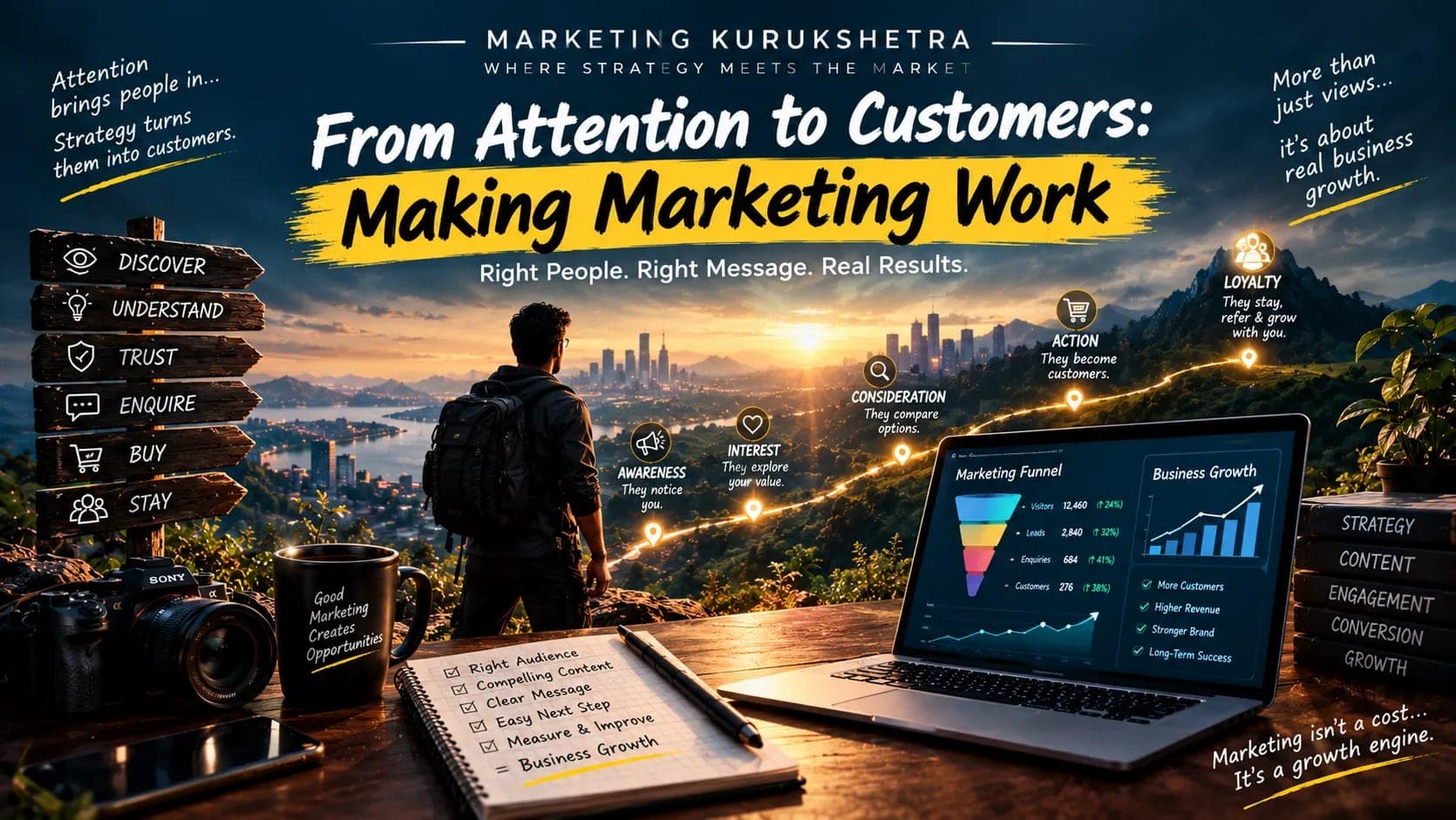
Attention Is Only the Beginning
A business publishes content, runs advertisements, gains followers, and receives thousands of views. The numbers look impressive, and the team feels encouraged.
But at the end of the month, sales remain unchanged.
This is where many businesses misunderstand marketing. They measure how many people saw their message without examining what happened afterward.
Attention matters because customers cannot consider a brand they never discover. But discovery alone does not create revenue. People must understand the offering, recognise its relevance, trust the business, and feel confident enough to take the next step.
Marketing is not simply the art of attracting attention. It is the discipline of moving the right people toward a meaningful decision.
The real question is not merely, “How many people saw us?”
It is, “What did the right people do after they discovered us?”
Build a Journey, Not Just a Campaign
Imagine a potential customer discovers your business through an Instagram post. They like the content, visit your profile, explore your website, and then leave without contacting you.
Was the marketing successful?
Perhaps it created awareness, but the customer's journey stopped before an enquiry.
Now imagine the same person finds a clear explanation of your service, sees relevant examples of your work, understands your pricing approach, and discovers an easy way to book a consultation. The next step becomes clearer because the business has reduced uncertainty.
This is the purpose of a marketing journey.
Every interaction should help the potential customer move from one stage to the next: discovering your brand, understanding your value, evaluating your credibility, making an enquiry, and deciding whether to purchase.
Not everyone will follow the same path. Some customers buy quickly; others need time, comparisons, and several conversations. Your responsibility is to make each stage useful and straightforward.
If your advertisements attract attention but your website creates confusion, improve the website. If people enquire but rarely purchase, investigate your sales process, pricing, offer, and follow-up.
Do not keep increasing traffic to a system that is losing potential customers along the way.
Give Customers Confidence to Choose You
People do not always avoid buying because they lack interest. Sometimes they hesitate because they lack confidence.
They may wonder whether your service will deliver the promised result, whether the price is justified, whether your business is reliable, or whether another option would be better.
Effective marketing addresses these concerns honestly.
Show relevant work. Explain your process. Make your offering understandable. Provide genuine testimonials where available. Answer common questions. Communicate limitations instead of hiding them.
For a commercial production company, this might mean presenting a relevant portfolio, explaining the production workflow, clarifying deliverables, and demonstrating how the work supports a client's objectives.
For a local service business, it might mean displaying clear service details, explaining how appointments work, and responding to enquiries professionally.
The objective is not to pressure people into buying. It is to give qualified customers enough information to make an informed decision.
Trust reduces uncertainty, and reduced uncertainty makes action easier.
Make the Next Step Obvious
Sometimes marketing fails for a surprisingly simple reason: people do not know what to do next.
They encounter an advertisement but cannot find the website. They visit the website but cannot understand the offer. They want to enquire but face a complicated form. They send a message but receive no useful response.
Every unnecessary obstacle can reduce the likelihood that interest becomes action.
Give each campaign a clear purpose. If you want people to book a consultation, make booking easy. If you want qualified enquiries, explain what information to provide. If you want customers to purchase, ensure the offer, pricing, and buying process are understandable.
Your call to action should match the customer's level of readiness. Someone discovering your brand for the first time may need an educational article, while someone comparing providers may be ready to request a quotation.
Do not demand a commitment before giving people enough reason to make one.
Measure What Moves the Business Forward
Marketing performance should be evaluated through more than likes, views, and follower counts.
Track the measures that connect your efforts to business outcomes: qualified enquiries, enquiry-to-sale conversion rate, customer acquisition cost, average order value, repeat purchases, and customer retention.
These measurements help you understand where your strategy is working and where it needs attention.
If a campaign generates many enquiries but few suitable prospects, your targeting or message may need refinement. If qualified prospects frequently reject your offer, examine your pricing, differentiation, credibility, and sales conversations.
If customers purchase once but never return, investigate the quality of their experience and the relevance of your ongoing communication.
Numbers do not explain everything by themselves, so combine measurement with conversations and customer feedback. The goal is not to chase every metric. It is to learn which activities produce meaningful results.
Start with a manageable budget, test your assumptions, and improve the parts of the journey that matter most before increasing your investment.
Turn Marketing Into a Growth System
Sustainable marketing is not one successful advertisement or one viral post. It is a connected system that attracts relevant people, communicates value, builds trust, supports decisions, and encourages customers to return.
When these elements work together, your marketing becomes easier to evaluate and improve.
Remember that a sale is not necessarily the end of the customer's journey. A satisfied customer may return, recommend your business, or introduce you to another valuable opportunity.
That is why growth should not depend entirely on finding new customers. It should also come from delivering a worthwhile experience to the customers who have already chosen you.
“Attention opens the door, trust invites the customer inside, and value gives them a reason to stay. Don't measure your marketing only by how many people notice your brand—measure how effectively you turn that attention into meaningful relationships and lasting business growth.”