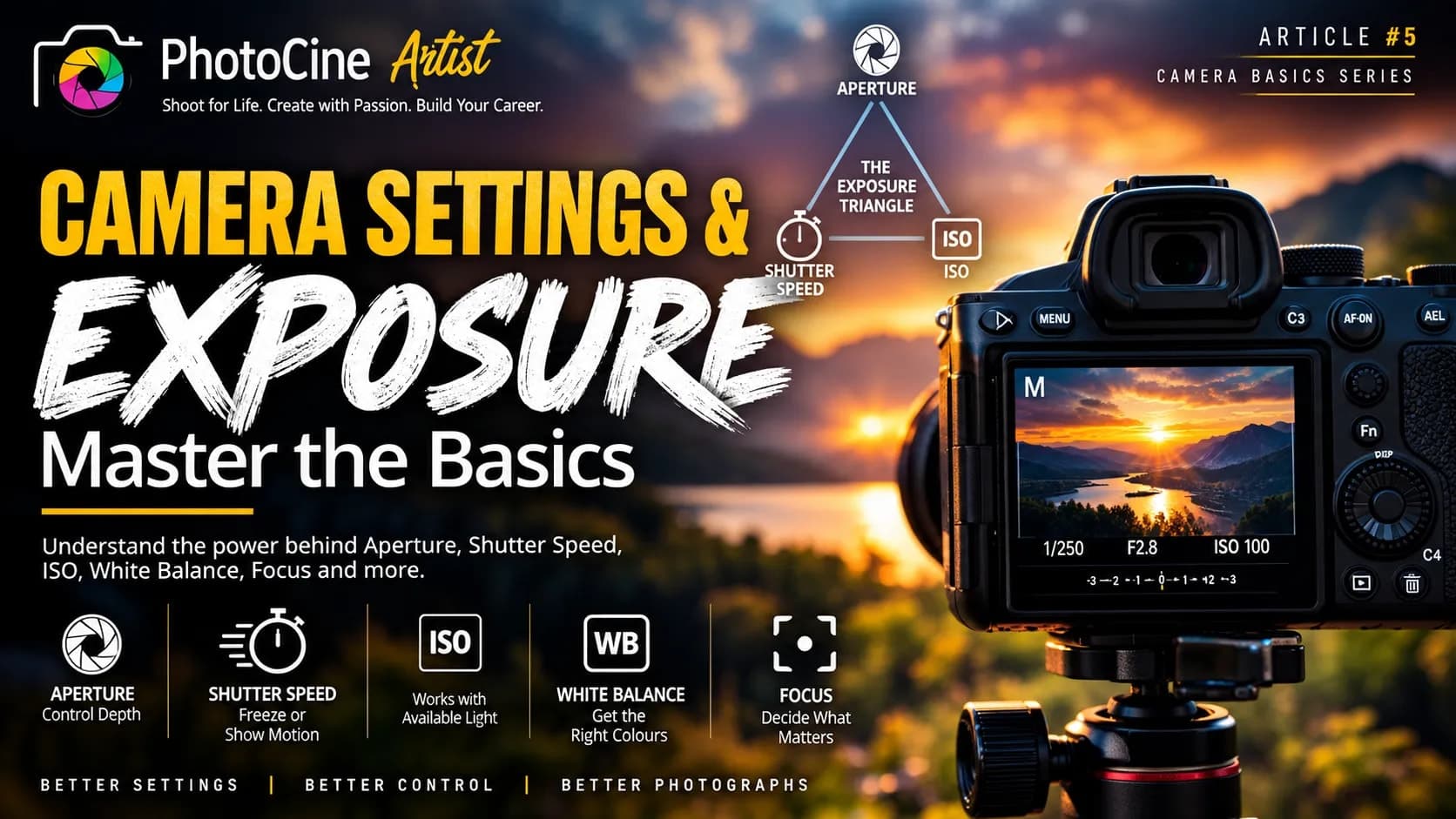
The Camera Does Not See Like You
A camera does not understand beauty.
It does not know why a sunset feels peaceful, why someone's eyes carry a story, or why a particular moment deserves to be remembered.
It simply receives light.
The artist decides what that light should become.
This is where camera settings begin to matter.
Aperture, shutter speed, ISO, white balance and focus are not merely technical controls hidden inside a camera menu. They are the vocabulary through which a photographer communicates with light.
Learning them is not about memorising numbers.
It is about understanding what those numbers allow you to create.
---
Exposure: The Foundation of Every Frame
Every photograph begins with exposure.
Exposure is essentially the amount of light recorded by your camera's sensor.
Too much light, and the image becomes bright and loses detail.
Too little light, and the image becomes dark, sometimes swallowing important information into shadows.
But perfect exposure does not always mean a photograph that looks perfectly bright.
Sometimes darkness creates mystery.
Sometimes brightness creates emotion.
Sometimes a silhouette says more than a perfectly exposed face ever could.
A PhotoCine Artist therefore does not simply ask:
"Is this correctly exposed?"
The better question is:
"Does this exposure communicate what I want to say?"
---
Aperture: Controlling Light and Depth
Aperture is the opening inside the lens through which light enters.
It is represented by f-stops, such as f/1.4, f/2.8, f/4, f/5.6 and f/8.
The interesting part is that smaller f-numbers represent larger openings.
At f/1.8, the lens allows considerably more light to enter and can create a shallow depth of field.
The subject becomes separated from the background.
At f/8, much more of the scene can remain in focus.
This makes aperture more than an exposure setting.
It becomes a storytelling tool.
A portrait photographed at f/1.8 can isolate a person's expression from the world around them.
A landscape photographed at f/8 or f/11 can allow the viewer to experience the entire scene.
The setting changes.
The story changes with it.
---
Shutter Speed: Controlling Time
Light is not the only thing a camera records.
It records time.
Shutter speed determines how long the camera's shutter remains open to capture light.
A fast shutter speed such as 1/1000 second can freeze a moving athlete, a flying bird or a splash of water.
A slower shutter speed such as 1/30 second can introduce motion blur.
And with much slower exposures, moving water can become silky, traffic can transform into trails of light, and stars can begin to paint themselves across the sky.
This is one of photography's greatest powers:
the ability to control how time appears.
The real world moves continuously.
The camera allows you to decide whether that movement should disappear, freeze or become part of the image.
---
ISO: Seeing When Light Is Limited
ISO controls the sensor's sensitivity to available light.
Lower ISO values such as ISO 100 generally produce cleaner images with less visible noise.
Higher values such as ISO 1600, 3200 or beyond allow you to work in darker environments, but can introduce more noise and reduce image quality depending on the camera.
This creates a common temptation among beginners:
"Keep ISO as low as possible."
But photography is not about following rules blindly.
If your subject is moving inside a dark room, using a higher ISO may be far better than using a shutter speed so slow that the photograph becomes blurred.
A noisy photograph can still contain emotion.
A perfectly clean photograph that misses the moment may contain nothing.
---
The Exposure Triangle
Aperture, shutter speed and ISO form what photographers commonly call the Exposure Triangle.
They work together.
Change one, and another may need to change.
For example:
Open the aperture → more light enters → you may increase shutter speed.
Increase shutter speed → less light enters → you may open the aperture or increase ISO.
Increase ISO → the camera can work with less available light → but image noise may increase.
Understanding this relationship is more important than memorising individual settings.
Eventually, you stop thinking:
"Which button should I press?"
And begin thinking:
"What does this scene require?"
That transition marks the beginning of real camera control.
---
Metering: Let the Camera Measure
Modern cameras are remarkably intelligent.
Their metering systems analyse the light in a scene and suggest an exposure.
Matrix or evaluative metering considers a broad portion of the frame.
Center-weighted metering gives greater importance to the centre.
Spot metering measures a much smaller area.
These systems are helpful.
But they are not artists.
A camera can measure light.
It cannot understand intention.
A bright subject against a dark background may confuse the camera into creating an exposure that is technically balanced but visually wrong.
The photographer must remain in control.
---
Exposure Compensation: A Small Adjustment With Big Impact
When shooting in an automatic or semi-automatic mode, exposure compensation allows you to intentionally make the image brighter or darker.
For example:
+1 EV → brighter exposure.
-1 EV → darker exposure.
This becomes particularly useful when the camera's meter interprets a scene differently from your creative intention.
Snow may need positive compensation because a camera can interpret a bright snowy scene as excessively bright.
A dramatic portrait may benefit from negative compensation to preserve shadows and atmosphere.
The camera gives you a recommendation.
You decide whether to accept it.
---
White Balance: Controlling the Feeling of Light
Not all light has the same colour.
Sunlight, shade, tungsten bulbs, fluorescent lights and LEDs can all produce different colour temperatures.
White balance helps the camera interpret these differences.
A photograph that is too warm may appear overly yellow or orange.
A photograph that is too cool may appear excessively blue.
But once again, technical correctness is not always the goal.
Warm light can make a scene feel intimate.
Cool light can create isolation.
A filmmaker may intentionally use contrasting colour temperatures to separate characters or create tension.
Colour therefore becomes part of visual storytelling.
---
Focus: Decide What Deserves Attention
Focus is not simply about making an image sharp.
It is about deciding where the viewer should look first.
Modern cameras offer multiple autofocus modes, including single-point AF, zone AF, wide-area AF and subject-tracking systems.
Eye autofocus can be incredibly useful for portraits and moving subjects.
But technology should support the artist rather than replace the artist.
A beautifully composed frame can lose its power if the camera focuses on the wrong subject.
The focus point is therefore a creative decision.
You are telling the viewer:
"Look here."
---
Focal Length Changes Perspective
Lens choice changes more than how much of the scene fits inside the frame.
Wide-angle lenses can exaggerate space and create a sense of scale.
Standard focal lengths can provide a perspective that feels natural and familiar.
Telephoto lenses can compress distances and isolate subjects.
Macro lenses allow us to discover details that ordinary vision often ignores.
This is why two photographers standing in the same location with different lenses can create completely different photographs.
The location is the same.
The vision is not.
---
Manual Mode Is Not the Goal
Many beginners believe that becoming a professional means shooting everything manually.
It does not.
Manual mode is a tool.
Aperture priority is a tool.
Shutter priority is a tool.
Automatic modes are tools.
The professional photographer is not the person who uses the most complicated settings.
The professional is the person who chooses the right tool without allowing the camera to interrupt the creative process.
If aperture priority allows you to react faster to changing light, use it.
If manual exposure gives you complete consistency during a commercial shoot, use it.
If autofocus tracks your subject better than you can manually, let it work.
Mastery is not complexity.
Mastery is control.
---
Stop Chasing the Perfect Settings
There is no universal camera setting for photography.
A wedding photographer working inside a dim venue needs different settings from a wildlife photographer standing under bright sunlight.
A product photographer working with controlled studio lights has completely different requirements from a street photographer walking through a city at night.
A cinematographer shooting a dialogue scene has different priorities from someone filming an action sequence.
The correct settings are determined by:
Light.
Subject.
Movement.
Lens.
Creative intention.
Once you understand those five things, camera settings stop feeling complicated.
---
Learn Through Experiments
The fastest way to understand settings is not simply to read about them.
Change them.
Photograph the same subject at:
f/1.8 → f/4 → f/8
Observe the background.
Then try:
1/1000 → 1/250 → 1/30
Observe movement.
Then experiment with:
ISO 100 → ISO 800 → ISO 3200
Observe the relationship between brightness and noise.
Do not worry about creating masterpieces during these experiments.
You are teaching your eyes.
Eventually, the numbers begin to develop meaning.
f/2.8 stops being a number.
It becomes separation.
1/1000 stops being a number.
It becomes motion frozen in time.
ISO 3200 stops being a number.
It becomes the possibility of shooting in darkness.
That is when technical knowledge becomes creative knowledge.
---
The Moment Settings Disappear
There will come a point when you stop consciously thinking about every setting.
You will walk into a room and instinctively understand the light.
You will see movement and know the shutter speed you need.
You will see a portrait and immediately imagine the depth of field.
You will notice a dark environment and understand how far you can push your ISO.
The camera will still have hundreds of settings.
But they will no longer stand between you and your subject.
You will simply see.
And then shoot.
That is the real purpose of learning your camera.
Not to become someone who knows every menu.
But to become someone who can turn an idea into an image without hesitation.
---
The Camera Is Only the Beginning
A camera can capture light.
A lens can shape perspective.
Settings can control exposure.
But none of these things can create meaning by themselves.
Meaning comes from the person standing behind the camera.
The PhotoCine Artist learns the technical language so deeply that technology eventually becomes invisible.
The goal is not to impress people with your settings.
The goal is to make them feel something when they see your frame.
Master the settings, but never let the settings master your vision; the camera should follow your imagination, not define it.