
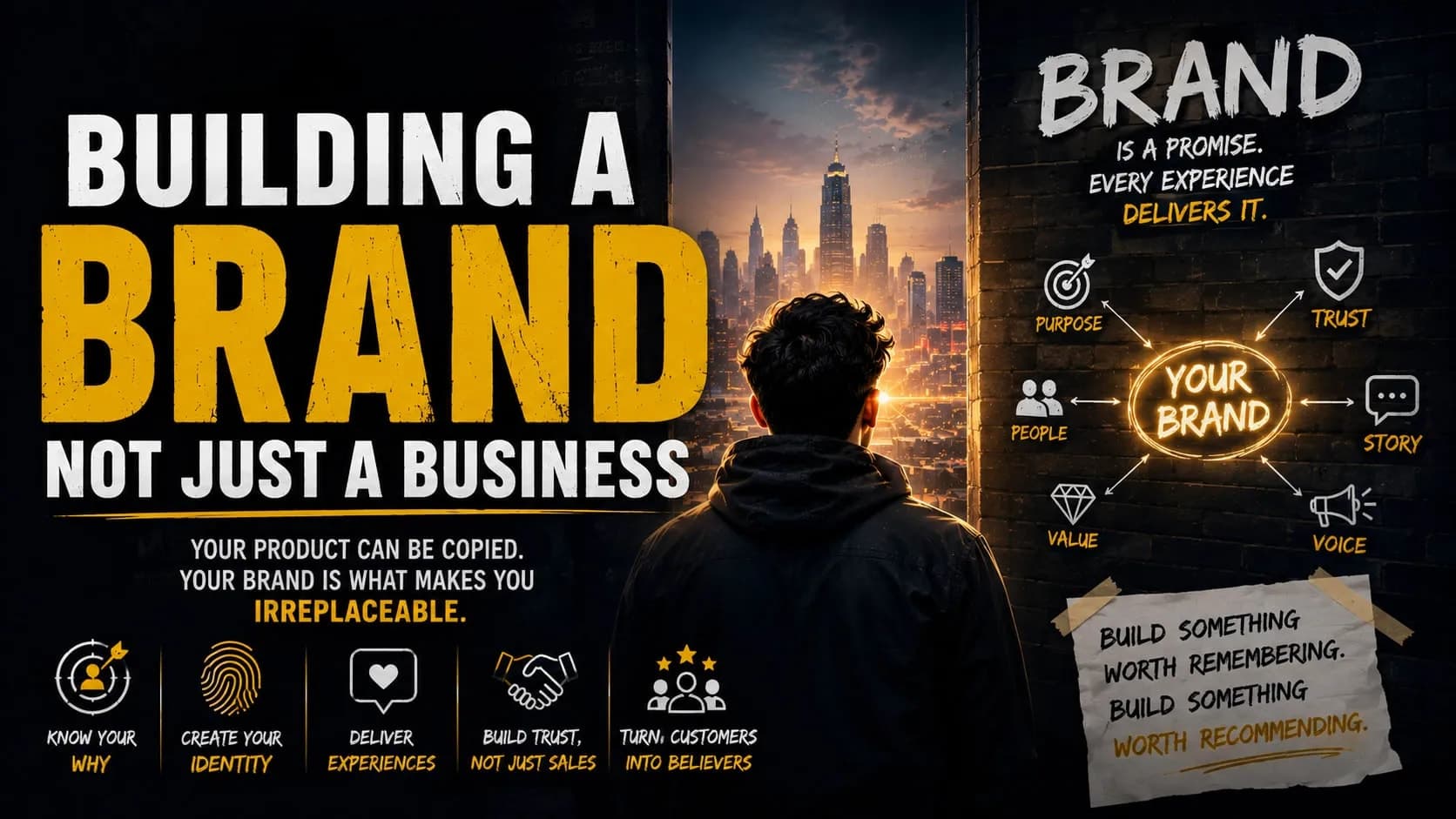
A business can sell a product.
A company can provide a service.
But a brand creates a feeling.
And sometimes, that feeling is more powerful than the product itself.
Think about the businesses you remember. You may not remember every product they sell. You may not remember their prices. You may not even remember when you first discovered them.
But you remember how they made you feel. You remember what they stood for. You remember their personality. You remember the experience. You remember the promise.
That is the difference between a business and a brand. A business asks: "What are we selling?"
A brand asks: "What do we want people to believe when they hear our name?" And that question changes everything.
When you start a business, your first priority is usually survival. You need customers. You need revenue. You need to deliver something valuable. You need to understand the market. You need to make money. And there is nothing wrong with that.
But eventually, if you want to build something that lasts, you have to move beyond simply selling. You have to create an identity.
Because there will always be someone who can copy your product. Someone can offer a similar service. Someone can lower the price. Someone can copy your website. Someone can reproduce your design. Someone can hire similar people. Technology makes imitation easier than ever.
So if your entire business depends on the thing you sell, you are vulnerable.
But when people begin associating your name with a certain quality, feeling, experience or belief, something changes.
You become harder to replace. That is the power of a brand. A brand is not simply a logo. It is not a colour palette. It is not a fancy tagline. It is not your Instagram page.
Those are expressions of a brand. The brand itself exists in the mind of the customer. It is what they think about when your name appears. It is what they expect from you. It is what they tell someone else about you. It is the reputation you have created through thousands of small interactions.
And reputation is built slowly. But it can disappear quickly. This is why branding is not decoration. Branding is expectation.
When someone sees your name, they should have an idea of what they are going to receive. Maybe they expect luxury. Maybe innovation. Maybe reliability. Maybe affordability. Maybe creativity. Maybe simplicity. Maybe speed. Maybe trust.
Whatever it is, you have to decide.
Because if you don't define your brand, the market will define it for you.
And you may not like what they decide.
Imagine two companies selling almost the same product. One says: "We sell shoes."
The other says: "We help people become who they want to be." They may sell similar physical products.
But they are not selling the same thing. One is selling an object. The other is selling an identity.
And people often make purchasing decisions based on identity.
They don't only ask: "What does this product do?"
They also ask: "What does choosing this product say about me?"
That is why some people pay more for something even when a cheaper alternative exists.
They aren't only buying the physical product.
They are buying trust. Experience. Status. Belonging. Convenience. Emotion. Identity. Story.
And that is where branding becomes powerful.
But building a brand begins with something much deeper than marketing.
It begins with knowing who you are.
The same question we asked when we started this Founder Mindset journey: What do you believe? What do you care about? What are you trying to change? What do you want to create? What do you refuse to compromise? What kind of world do you want your business to contribute to?
Because a brand without a belief becomes noise. You can create beautiful advertisements. You can hire the best designers. You can spend millions on marketing.
But if there is nothing meaningful underneath, people eventually see through it.
People may discover your brand through advertising.
But they stay because of the experience.
And they become loyal because of trust.
That is why your brand promise matters.
A promise is not something you write on a wall.
It is something you repeatedly prove.
If you say you are premium, your experience has to feel premium.
If you say you are fast, you have to be fast.
If you say you care about customers, your customer service has to prove it.
If you say you are innovative, your product has to evolve.
If you say you believe in quality, you cannot compromise quality simply because nobody is watching.
Your brand is what happens when your promise meets reality.
And every employee becomes part of that promise.
This is why building a brand becomes more difficult as the company grows.
When you are alone, your personality controls almost everything.
You answer the customer.
You write the message.
You deliver the work.
You make the decisions.
You represent the company.
But when you have fifty employees, you can't personally control every interaction.
Your team becomes the face of your brand. Your systems become part of your brand. Your website becomes part of your brand. Your packaging becomes part of your brand. Your customer support becomes part of your brand. Your invoices become part of your brand. Even the way you handle a complaint becomes part of your brand.
Because customers don't experience your company through your mission statement.
They experience it through interactions. And every interaction tells them something. That is why consistency matters.
If your website says one thing, your employees say another, and your product delivers something completely different, people become confused.
A strong brand creates alignment.
The same values should appear everywhere. Not identically. But consistently. Your visuals. Your language. Your behaviour. Your service. Your product. Your people. Your decisions.
Everything should feel like it belongs to the same company.
This doesn't mean becoming boring.
In fact, the strongest brands often have very strong personalities.
They know who they are.
They know who they are not.
And they are not afraid to say it.
That is important. Because you cannot be everything to everyone.
If you try to appeal to everyone, you often become memorable to nobody.
A strong brand knows its audience. Who are they? What do they want? What are they afraid of? What do they value? What do they aspire to become? What frustrates them? What kind of experience do they expect?
Understanding these things allows you to communicate with them differently.
You stop shouting: "Buy my product!"
And start saying: "I understand your problem."
That changes marketing completely.
Because good marketing isn't about talking more.
It is about understanding better. The customer doesn't wake up thinking about your business. They wake up thinking about their own life. Their problems. Their goals. Their family. Their career. Their dreams. Their frustrations.
So if your communication only talks about yourself, people may not care.
But if you show them that you understand them, they listen. This is why storytelling is so powerful.
Humans have always understood the world through stories. Stories give meaning to facts. A product has specifications. A brand has a story. A company has a journey. A founder has a reason. A customer has a problem.
And the interaction between these creates meaning.
Your story doesn't need to be dramatic.
It simply needs to be true. Why did you start? What problem did you see? What frustrated you? What did you believe could be better? What were you trying to change? What did you struggle with? What did you learn? Where are you going? People don't need perfection. They often connect more deeply with authenticity.
They want to know there are real people behind the company.
But authenticity doesn't mean telling the world everything.
It means making sure what you communicate is consistent with what you actually believe.
Don't create a personality for your brand that your company cannot sustain.
If your brand pretends to be something it isn't, eventually the gap becomes visible. And trust disappears.
Trust is one of the most valuable assets a brand can build. It takes years to create.
But sometimes one careless decision can damage it. A delayed delivery may be forgiven. A mistake may be forgiven. A bad day may be forgiven. But dishonesty is much harder to forget.
This is why reputation should be treated like an asset. You can measure revenue. You can measure profit. You can measure customers. But reputation is harder to measure.
And yet it can determine all of those numbers.
A strong reputation lowers the resistance between you and the customer.
People are more willing to try you. More willing to recommend you. More willing to pay you. More willing to forgive an occasional mistake. More willing to stay. Trust reduces friction.
And over time, trust becomes an economic advantage. But trust isn't created by saying: "Trust us."
It is created by repeatedly giving people reasons to trust you. Keep your promises. Admit mistakes. Communicate clearly. Treat customers fairly. Pay your people properly. Don't manipulate. Don't make claims you cannot support. Do the right thing even when doing the wrong thing would be easier.
Because eventually, your actions become your reputation. And your reputation becomes your brand.
There is also another side to branding that entrepreneurs sometimes ignore: internal branding.
Your employees should know what the company stands for. Not because you want them to memorize a mission statement. But because they should understand the philosophy behind their work.
If a customer has a problem, what should they prioritize?
If there is a conflict between speed and quality, what matters more?
If they discover a mistake, should they hide it or report it?
If a customer asks for something unusual, should they immediately say no or find a solution?
These decisions become easier when people understand the values of the organization. Culture is the internal side of branding. Your customers experience the brand outside. Your employees experience it inside.
And if those two worlds are completely different, eventually the customer will notice.
That is why you cannot build a strong external brand with a broken internal culture. Your employees are not machines.
They are human beings representing your company. If they feel respected, they are more likely to respect the customer.
If they believe in the mission, they are more likely to protect it.
If they feel ownership, they are more likely to care. This is why leadership and branding are connected.
A founder's behaviour eventually becomes part of the company culture.
And culture eventually becomes part of the customer experience.
So if you want to build a powerful brand, start with the inside.
Build something you would be proud to put your own name on. Because eventually, your name may become associated with everything the company does.
That is both the privilege and the responsibility of being a founder.
Your name may become a symbol. A symbol of quality. A symbol of creativity. A symbol of trust. A symbol of innovation.
Or unfortunately, a symbol of something negative. That is why every decision matters. Every customer interaction is a brick. Every product is a brick. Every employee is a brick. Every advertisement is a brick. Every mistake and every recovery is a brick.
And slowly, those bricks create the reputation people call your brand.
You don't build a brand in one campaign. You build it one experience at a time.
And sometimes the strongest brand-building doesn't happen through advertising at all.
It happens when a customer tells a friend: "You should work with them."
It happens when someone chooses your company without comparing five competitors.
It happens when a customer returns even though another company is cheaper.
It happens when someone wears your product because they feel connected to what it represents.
It happens when an employee proudly tells someone where they work.
It happens when your name becomes associated with a particular standard.
That is when you know the brand is becoming real.
But don't confuse popularity with branding. Going viral is not the same as building a brand. A viral moment can bring attention. But attention without trust disappears quickly.
Millions of views mean very little if nobody remembers you tomorrow.
A strong brand can survive moments when you are not trending.
Because it is built on something deeper than attention. It is built on recognition and trust. And this is where patience becomes important again. You may spend money on advertising today and see results tomorrow.
But brand equity can take years to develop. It is a long-term investment. Every interaction adds something. Every customer adds something. Every year adds something.
Eventually, the accumulated trust becomes an asset. And that asset can become one of the most valuable things your company owns.
Not because it sits on a balance sheet in the traditional sense.
But because it influences behaviour. It influences choice. It influences pricing. It influences loyalty. It influences partnerships. It influences talent.
People want to work for brands they respect. Customers want to buy from brands they trust. Partners want to work with brands that have credibility.
That is why branding isn't simply about customers.
It affects the entire ecosystem around your business. And as your company grows, your brand may become bigger than your original product.
This happens when people begin trusting your name enough to accept new things from you. You started with one product. Then people believe you can create another. You started in one market. Then people believe you can enter another. You started with one service.
Then your reputation allows you to introduce something completely new. That is brand leverage.
But it must be earned. You cannot simply attach your name to everything.
If you launch ten unrelated products and none of them reflect your original promise, you can weaken the brand instead of strengthening it. Expansion should still make sense.
Ask: Does this belong to us? Does this fit our identity? Does this serve our customer? Does this strengthen the brand or dilute it?
Because sometimes the most powerful thing a brand can say is: "That's not who we are." And that takes confidence.
The world will constantly give you reasons to change. Competitors will copy you. Trends will appear. People will tell you what you should become. Some advice will be valuable. Some won't.
Your job is to listen without losing yourself. Adapt without becoming unrecognizable. Evolve without abandoning your core.
Because a brand should have roots and branches. The roots are your values. The branches are how you express them as the world changes. If you have only roots, you become rigid. If you have only branches, you lose your identity. You need both.
This is why some of the strongest companies can change their products, technology, design and communication while still feeling unmistakably like themselves. Their expression changes. Their essence doesn't.
And perhaps that is what every entrepreneur should aim for. Build something that can evolve without losing its soul. Because markets change. Technology changes. Customers change.
But the reason you exist can remain. And that reason becomes the foundation of the brand.
So when you build your next business, don't begin only with: "What can I sell?"
Ask: "What can I stand for?"
Don't ask only: "How can I get customers?"
Ask: "Why should they remember me?"
Don't ask only: "How can I make people buy?"
Ask: "How can I create enough value that they want to return?"
Don't ask only: "How can I become popular?"
Ask: "How can I become trusted?"
Because popularity gives you attention. Trust gives you time. And time gives you the opportunity to build something lasting.
A business may begin because you found an opportunity. But a brand becomes powerful when people begin finding meaning in what you built.
And that is when your company stops being just another name in the market. It becomes a choice. Then a preference. Then a habit. Then a relationship.
And eventually, perhaps, a part of someone's identity. That is the journey from business to brand. It doesn't happen overnight. It doesn't happen because of a logo. It doesn't happen because you spent more money on advertising.
It happens because you repeatedly deliver on a promise. You create something valuable. You treat people well. You communicate clearly. You stay consistent. You evolve. You protect your reputation.
And you give people a reason to believe that your name means something.
Because at the end of the day, a brand is not what you say about yourself.
It is what people remember about you when you're not in the room.
And perhaps that is the ultimate goal. Not simply to have your name known. But to have your name mean something. Something valuable. Something trustworthy. Something worth choosing. Something worth remembering. Something worth passing to the next generation.
Because when a business becomes a brand, it stops being only about what you sell today.
It becomes about what your name promises tomorrow. And when that promise survives the founder, survives the product, survives the market and survives the years— you haven't simply built a business. You have built an identity that can become a legacy.
"A business is built by what you sell; a brand is built by what people believe—and a legacy is built when that belief survives long after you are gone."
K.S. Lakhotia